Monday, October 31, 2022

La Giralda

La Giralda, Avenida de la Constitución, Seville

La Giralda
Avenida de la Constitución
Seville, September 2022

“The Giralda (Spanish: La Giralda) is the bell tower of Seville Cathedral in Seville, Spain.[1] It was built as the minaret for the Great Mosque of Seville in al-Andalus, Moorish Spain, during the reign of the Almohad dynasty, with a Renaissance-style belfry added by the Catholics after the expulsion of the Muslims from the area. The Giralda was registered in 1987 as a World Heritage Site by UNESCO, along with the Alcázar and the General Archive of the Indies. The tower is 104.1 m (342 ft) in height and remains one of the most important symbols of the city, as it has been since the Middle Ages.” (Giralda, Wikipedia)

Sunday, October 30, 2022

Torres de Serranos

Torres de Serranos (Serranos Towers), Plaza de los Fueros, Valencia

Torres de Serranos (Serranos Towers)
Plaza de los Fueros
Valencia, September 2022

“Under the supervision of Pere Balaguer, construction began in 1392. The towers were designed to be defensive structures at one of the busiest city gates. They were saved from demolition when the city walls were knocked down in 1865 and used as a prison for the nobility between 1586 and 1887. The back of the towers have been opened so that the pointed arches and the vaulted domes can now be seen from the Plaza de los Fueros. The Towers represent an excellent example of gothic architecture.” (Serranos Towers, Visit Valencia)

Saturday, October 29, 2022

Victoria

Victoria (Victory) by Juan de Ávalos, Monumento a la gesta del Alcázar, Calle de la Union, Toledo

“Victoria” (Victory) by Juan de Ávalos, 1961
Monumento a la gesta del Alcázar
Calle de la Union
Toledo, September 2022

“The origin of the name Zocodover comes from the Arabic language sūq ad-dawābb, which means ‘market of burden beasts’. This place was also the place where bullfighting and the cucañas were organized in the celebrations of the locality. It has been, therefore, the nerve center of the social life of the city since medieval times. But Zocodover was also a center for more mournful acts like the autos-da-fé of the Inquisition or the public execution of the prisoners. It is when the old square was destroyed by a fire on October 29, 1589 that the decision was taken to build a new one. In 1854 an ambitious project is drawn up, by the hand of the technician Santiago Martín Ruiz, to reorganize the plaza de Zocodover, transforming it into a rectangular portico square.” (Plaza de Zocodover, Wikipedia)

Friday, October 28, 2022

Rana de la fortuna

Rana de la fortuna (Lucky Frog) by Eladio de Mora, Paseo de Recoletos, Madrid

Rana de la fortuna (Lucky Frog) by Eladio de Mora, 2014
Paseo de Recoletos
Madrid, September 2022

“Lucky Frog (Rana de la fortuna) is a bronze sculpture by the Spanish artist dEmo, installed in Madrid, Spain, in 2014, outside the Casino Gran Madrid on the Paseo de Recoletos. The sculpture is 5 metres (16 ft) tall and weighs 2,000 kilograms (4,400 lb). The work was commissioned for the opening of the casino, and was a gesture of thanks to the city for restoring legal gambling after 90 years. It was unveiled on 3 April 2014 by journalist Carme Chaparro and actor Paco León. The frog is a sign of good fortune in Feng shui and its underbelly is engraved with symbols of good luck from world cultures. The 34 symbols include several numbers as well as pictures including a scarab artifact, a four-leaf clover, the peace sign and various currency symbols and religious signs. The patina, the protective coating on the metal, was applied by specialist Juan Manuel González. Its turquoise green is also considered lucky.” (Lucky Frog, Wikipedia)

Thursday, October 27, 2022

Statue of Maimónides

Statue of Maimónides by Amadeo Olmos Ruiz, Plaza de Tiberíades, Córdoba

Statue of Maimónides by Amadeo Olmos Ruiz, 1964
Plaza de Tiberíades
Córdoba, September 2022

“Maimonides was born in Cordoba on 30th March 1135, from a notable Cordoban family - his father was a lawyer and a leader of the Jewish Quarter, or judería. He received his early education in the synagogue school, but his studies of mathematics and medicine were written in Arabic. After an edict against the Jews, he was forced to leave Spain and travelled to a number of cities before settling in Cairo, where he worked as a merchant of precious stones. Maimonides was the greatest, most universal and the most influential Jewish-Cordoban thinker. He left a wide and varied series of works both in Arabic and Hebrew – medical treatises, theological writings and philosophical tracts. Jewish thinking reached its zenith with the writings of Maimonides, and he was named nagid (chief) by the Jewish community. He died in Cairo on 12th December 1204.” (Maimónides, Turismo de Córdoba)

Wednesday, October 26, 2022

Templete del Triunfo

Templete del Triunfo de Nuestra Señora del Patrocinio by José Tomás Zambrano, Calle Santo Tomás, Seville

Templete del Triunfo de Nuestra Señora del Patrocinio by José Tomás Zambrano, 1756
Calle Santo Tomás, Plaza del Triunfo
Seville, September 2022

Tuesday, October 25, 2022

L'Oceanogràfic

L'Oceanogràfic (The Oceanographic), Carrer d'Eduardo Primo Yúfera, Ciutat de les Arts i de les Ciències (City of Arts and Sciences), Valencia

L'Oceanogràfic (The Oceanographic)
Carrer d'Eduardo Primo Yúfera
Ciutat de les Arts i de les Ciències (City of Arts and Sciences)
Valencia, September 2022

“The Oceanographic is the largest complex of its type in Europe, spanning 110,000 square metres (1,200,000 sq ft) and holding a capacity of 42,000,000 litres (11,000,000 US gal) of water, including a 26,000,000-litre (6,900,000 US gal) dolphinarium and a 7,000,000-litre (1,800,000 US gal) ocean tank with sharks, rays and other fish. It is home to 45,000 animals from 500 different species—including sharks, penguins, dolphins, sea lions, walruses, beluga whales, birds, reptiles and invertebrate—all inhabiting nine two-tiered underwater towers representing the Earth's major ecosystems. The aquariums utilize sea water pumped from the La Malva-Rosa beach. The park is divided into ten areas: the marine areas are arranged into Mediterranean habitats, the Arctic oceans, islands, the tropics, the temperate seas and the Red Sea. The park also includes a dolphinarium, an area of mangrove swamps and marshland, and a garden with more than 80 different species of plants.” (L'Oceanogràfic, Wikipedia)

Monday, October 24, 2022

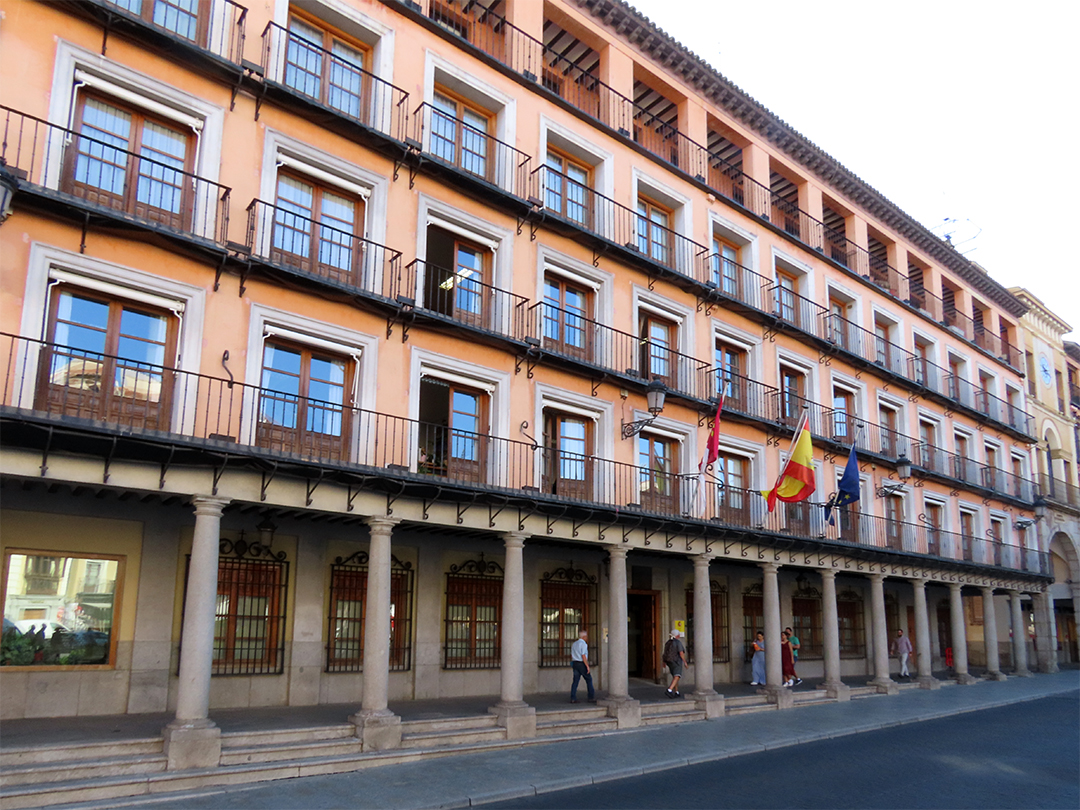
Delegación del Gobierno

Delegación del Gobierno, Plaza de Zocodover, Toledo

Delegación del Gobierno
Plaza de Zocodover
Toledo, September 2022

“The origin of the name Zocodover comes from the Arabic language sūq ad-dawābb, which means ‘market of burden beasts’. This place was also the place where bullfighting and the cucañas were organized in the celebrations of the locality. It has been, therefore, the nerve center of the social life of the city since medieval times. But Zocodover was also a center for more mournful acts like the autos-da-fé of the Inquisition or the public execution of the prisoners. It is when the old square was destroyed by a fire on October 29, 1589 that the decision was taken to build a new one. In 1854 an ambitious project is drawn up, by the hand of the technician Santiago Martín Ruiz, to reorganize the plaza de Zocodover, transforming it into a rectangular portico square.” (Plaza de Zocodover, Wikipedia)

Sunday, October 23, 2022

Torres Blancas

Torres Blancas by Francisco Javier Sáenz de Oiza, Avenida de América, Madrid

Torres Blancas by Francisco Javier Sáenz de Oiza, 1969
Avenida de América
Madrid, September 2022

“Torres Blancas is a mixed use concrete building in Madrid, Spain, designed in 1961 by Spanish architect Francisco Javier Sáenz de Oiza. The structure is a noted example of Spanish Organicism. Spanish industrialist Juan Huarte commissioned the project which initially included two residential towers.” (Torres Blancas, Wikipedia)

Saturday, October 22, 2022

Statue of Averroes

Statue of Averroes by Pablo Yusti Conejo, Calle Cairuan, Córdoba

Statue of Averroes by Pablo Yusti Conejo, 1967
Calle Cairuan
Córdoba, September 2022

“In an attractive setting, in front of the city walls, stands a magnificent statue of a seated man, deep in thought, but revealing at the same time all his dynamism, energy and inner drive. It is the statue of the most outstanding of all the Cordoban Arab writers and arguably the most influential philosopher of the Arab world, the great Averroes (1126-1198). He was born in Cordoba in 1226, the same year his grandfather died. His grandfather had been qadi (Moslem religious judge), civil judge and an important official in Cordoba – positions his father now held. Averroes followed suit, and for his contemporaries he was better known as a judge than as a philosopher. He was a highly-educated man who led a profoundly intellectual existence and who won fame as a doctor, astronomer, expert in law and above all, as a philosopher. In 1153 he was in Morocco masterminding reforms in higher education for the Almohad sultan. In 1169 he was named qadi of Seville, but he returned to Cordoba two years later as qadi, although he constantly travelled back and forth to Seville and Morocco. He was named qadi for a second time in Seville in 1179, and returned three years later as Great qadi of Cordoba. A few months previously he had replaced Ibn Tufayl as the sultan’s personal physician, continuing when Almanzor came to power (1184); he retained this position for good, only interrupted by a faux pas in 1195 which led to a short period of exile in Lucena. Once in the ruler’s good books again, he returned to the court in 1198, but this time in Morocco, where he put the finishing touches to his works for the few months remaining before his death.” (Averroes, Turismo de Córdoba)

Friday, October 21, 2022

Torre Triana

Torre Triana by Francisco Javier Sáenz de Oiza, Calle Juan Antonio de Vizarrón, Seville

Torre Triana by Francisco Javier Sáenz de Oiza, 1993
Calle Juan Antonio de Vizarrón
Seville, September 2022

“Torre Triana, an administrative building of the Government of Andalusia in Seville, was built in 1993. It was designed by the Navarran architect Francisco Javier Saenz de Oiza, inspired from the Sant'Angelo castle of the city of Rome. It is the largest administrative building of the Government of Andalusia. Postmodern style with the yellow color and circular shape makes the building very particular.” (Torre Triana, Architectuul)

Thursday, October 20, 2022

Catedral de Santa María

Catedral de Santa María, Plaza de la Virgen, Valencia

Catedral de Santa María
Plaza de la Virgen
Valencia, September 2022

“Valencia Cathedral, at greater length the Metropolitan Cathedral–Basilica of the Assumption of Our Lady of Valencia, also known as St Mary's Cathedral, is a Roman Catholic church in Valencia, Spain. The cathedral was consecrated in 1238 by the first bishop of Valencia after the Reconquista, Pere d'Albalat, Archbishop of Tarragona, and was dedicated to Saint Mary by order of James I the Conqueror. It was built over the site of the former Visigothic cathedral, which under the Moors had been turned into a mosque. Valencian Gothic is the predominant architectural style of the cathedral, although it also contains Romanesque, French Gothic, Renaissance, Baroque and Neoclassical elements. The cathedral contains numerous 15th-century paintings, some by local artists (such as Jacomart), others by artists from Rome engaged by the Valencian Pope Alexander VI who, when still a cardinal, made the request to elevate the Valencian See to the rank of metropolitan see, a category granted by Pope Innocent VIII in 1492.” (Valencia Cathedral, Wikipedia)

Wednesday, October 19, 2022

Torreón occidental

Torreón occidental (Western tower), Puente de Alcántara, Toledo

Torreón occidental (Western tower) Puente de Alcántara
Toledo, September 2022

“During the reign of Alfonso X of Castile it suffered serious damage and was rebuilt. The western tower belongs to this period, later decorated under the reign of the Catholic Monarchs, whose arms decorate its walls. The fruit of the pomegranate (the emblem of Granada) is missing from them, because the Reconquista had not finished at that time.” (Puente de Alcántara, Wikipedia)

Tuesday, October 18, 2022

Palacio de Cibeles

Palacio de Cibeles by Antonio Palacios and Joaquín Otamendi, Plaza de Cibeles, Madrid

Palacio de Cibeles by Antonio Palacios and Joaquín Otamendi, 1919
Plaza de Cibeles
Madrid, September 2022

“Cibeles Palace (Palacio de Cibeles), formally known as Palacio de Comunicaciones (Palace of Communications) and Palacio de Telecomunicaciones (Palace of Telecommunications) until 2011, is a complex composed of two buildings with white facades and is located in one of the historical centres of Madrid, Spain. Formerly the city's main post office and telegraph and telephone headquarters, it is now occupied by Madrid City Council, serving as the city hall, and the public cultural centre CentroCentro.” (Cybele Palace, Wikipedia)

Monday, October 17, 2022

Statue of Seneca

Statue of Seneca by Amadeo Ruiz Olmos, Calle Puerta de Almodóvar, Córdoba

Statue of Seneca by Amadeo Ruiz Olmos, 1965
Calle Puerta de Almodóvar
Córdoba, September 2022

“This monument to the Cordoban philosopher stands next to Puerta de Almodovar. Seneca was born in Cordoba in the 4th year B.C. and then went to Rome to complete his studies. During the reign of Claudius, he was a member of the senate, and around 50 A.D. was named a praetor by Nero, and in 56, a consul. Several years later, he retired and dedicated his time to reading, meditation and writing some of his best philosophical works. He had studied alongside grammarians, philosophers and rectors, and all his work was imbued with the Stoic doctrine. Seneca tried his hand at a range of literary styles, of which only some of his tragedies but most of his philosophical works have survived to this day, and the topics he mainly dealt with were ethical issues, theological problems and political theory. One of his most important works in the treatise On the Tranquillity of the Soul, written during his decline. However, the end of his life was far from tranquil, and he was accused of conspiracy and sentenced to death by Nero, although Seneca preferred to take his own life instead.” (Séneca, Turismo de Córdoba)

Sunday, October 16, 2022

Torre del Oro

Torre del Oro, Paseo de Cristóbal Colón, Seville

Torre del Oro
Paseo de Cristóbal Colón
Seville, September 2022

“The Torre del Oro (Arabic romanized: burj aḏẖ-ḏẖahab, lit. Tower of Gold) is a dodecagonal military watchtower in Seville, southern Spain. It was erected by the Almohad Caliphate in order to control access to Seville via the Guadalquivir river. Constructed in the first third of the 13th century, the tower served as a prison during the Middle Ages. Its name comes from the golden shine it projected on the river, due to its building materials (a mixture of mortar, lime and pressed hay). The tower is divided into three levels, the first level, dodecagonal, was built in 1220 by order of the Almohad governor of Seville, Abù l-Ulà; As for the second level, of only 8 meters, also dodecagonal, was built by Peter of Castile in the fourteenth century, a hypothesis that has been confirmed by archaeological studies; The third and uppermost being circular in shape was added after the previous third level, Almohad, was damaged by the 1755 Lisbon earthquake. Rebuilding of the third level was made by Brusselian military engineer Sebastian Van der Borcht in 1760.” (Torre del Oro, Wikipedia)

Saturday, October 15, 2022

Virgen de los Desamparados

Dome with frescos by Antonio Palomino, Basílica de la Virgen de los Desamparados, Plaza de la Virgen, Valencia

Dome with frescos by Antonio Palomino, 1701
Basílica de la Virgen de los Desamparados
Plaza de la Virgen
Valencia, September 2022

“This temple, built upon the ruins of the Roman forum and dedicated to the patron of the city, is linked to the cathedral by way of a Renaissance arch. Everything inside revolves around the statue of the Virgin, a Gothic sculpture with the head leaning slightly to one side, and covered with a robe and jewels. In the XVIII century, the two innocents who are at her feet were added, and the whole thing is now set upon a mechanical device which allows the statue to revolve. The central nave is covered by an oval-shaped dome, with frescos painted by Antonio Palomino.” (Basílica de la Virgen de los Desamparados, Valencia City Guide)

Friday, October 14, 2022

Puerta de Bisagra

Puerta de Bisagra or Puerta de Alfonso VI, Calle Real del Arrabal, Toledo

Puerta de Bisagra
Calle Real del Arrabal
Toledo, September 2022

“The Puerta de Bisagra (originally Bab al-Saqra, also called Puerta de Alfonso VI) is a city gate of Toledo, Spain. The structure was constructed in the 10th century, in the time of the Moorish Taifa of Toledo in Islamic Al-Andalus. It is also called 'Bisagra Antigua' to distinguish it from the Puerta de Bisagra Nueva which was built in 1559. The gate was the main entrance to the city and dates from the Moorish period.” (Puerta de Bisagra, Wikipedia)

Thursday, October 13, 2022

Palacio de Cristal

Palacio de Cristal (Glass Palace) by Ricardo Velázquez Bosco, Paseo de Cuba, Parque del Retiro, Madrid

Palacio de Cristal (Glass Palace) by Ricardo Velázquez Bosco, 1887
Paseo de Cuba
Parque del Retiro
Madrid, September 2022

“The Palacio de Cristal (Glass Palace) is a conservatory located in Madrid's Buen Retiro Park. The Palacio de Cristal, in the shape of a Greek cross, is made almost entirely of glass set in an iron framework on a brick base, which is decorated with ceramics. Its cupola makes the structure over 22 metres high. When it was erected, glass and iron construction on a large scale was already to be seen in Madrid at Delicias station (1880), the work of a French architect; however, the curved architecture of the Palacio de Cristal is more comparable to the techniques pioneered by the British architects Joseph Paxton (who was responsible for London's Crystal Palace) and Decimus Burton (who was responsible for the Palm House at Kew Gardens). The Palacio de Cristal was, alongside the Pabellón Central, one of the main venues of the 1887 Philippines Exposition. The cast-iron frame was manufactured in Bilbao. The structure was designed in a way that would allow it to be re-erected on another site (as happened to the equivalent building in London). However, the building has remained on the original site, next to a lake, and has been restored to its original appearance. It is no longer used as a greenhouse, and is currently used for art exhibits.” (Palacio de Cristal del Retiro, Wikipedia)

Wednesday, October 12, 2022

Cuesta del Bailío

Cuesta del Bailío (The Bailio Steps), Calle Alfaros, 
Córdoba

Cuesta del Bailío (The Bailio Steps)
Calle Alfaros
Córdoba, September 2022

“The central street calle Alfaros leads to the street named Cuesta del Bailío (the Bailio Steps), which was originally one of the entrances of the city walls which connected the Axerquia with the Medina. At the top stands the Casa del Bailío (Bailio House), with its attractive Renaissance façade. This well-loved street leads to the square Plaza de Capuchinos, with the popular statue of Cristo de los Faroles (Christ of the Lanterns) at one end.” (Cuesta del Bailío, Turismo de Córdoba)

Tuesday, October 11, 2022

Las Setas

Las Setas (The Mushrooms), Metropol Parasol, Plaza de la Encarnación, Seville

“Las Setas” (The Mushrooms), Metropol Parasol
Plaza de la Encarnación
Seville, September 2022

“Setas de Sevilla (Mushrooms of Seville) or Las Setas (The Mushrooms), initially titled Metropol Parasol, is a wooden structure located at La Encarnación square in the old quarter of Seville, Spain. It was designed by the German architect Jürgen Mayer and completed in April 2011. It has dimensions of 150 by 70 metres (490 by 230 ft) and an approximate height of 26 metres (85 ft) and claims to be the largest wooden structure in the world. Its appearance, location, delays and cost overruns in construction resulted in much public controversy.” (Metropol Parasol, Wikipedia)

Monday, October 10, 2022

Palau de les Arts Reina Sofía

Palau de les Arts Reina Sofía, Avinguda del Professor López Piñero, Valencia

Palau de les Arts Reina Sofía by Santiago Calatrava, 2005
Avinguda del Professor López Piñero
Valencia, September 2022

“Palau de les Arts Reina Sofía (Palacio de las Artes Reina Sofía; anglicised as ‘Queen Sofía Palace of the Arts’) is an opera house, performing arts centre, and urban landmark designed by Santiago Calatrava to anchor the northwest end of the City of Arts and Sciences in Valencia, Spain. It opened on 8 October 2005; its first opera staging was of Beethoven's Fidelio on 25 October 2006. Tenor and conductor Plácido Domingo has maintained a special relationship with the Palau since its founding and has established a young singers training program there.” (Palau de les Arts Reina Sofía, Wikipedia)

Sunday, October 9, 2022

Cristo de la Luz

Ermita del Cristo de la Luz, Calle Cristo de la Luz, Toledo

Ermita del Cristo de la Luz
Calle Cristo de la Luz
Toledo, September 2022

“The Mosque of Cristo de la Luz is a Catholic chapel and former mosque in Toledo, Spain. It is the one of the ten that existed in the city during the Moorish period. The edifice was then known as Mezquita Bab-al-Mardum, deriving its name from the city gate Bab al-Mardum. It is located near the Puerta del Sol, in an area of the city once called Medina where wealthy Muslims used to live.” (Cristo de la Luz, Wikipedia)

Saturday, October 8, 2022

Accidente aéreo

Accidente aéreo (Aerial Accident) by Miguel Angel Ruiz, Calle de los Milaneses, Madrid

“Accidente aéreo” (Aerial Accident) by Miguel Angel Ruiz, 2006
Calle de los Milaneses
Madrid, September 2022

“The sculptor, Miguel Angel Ruiz, amicably explained to us that his work was neither a Fallen Angel nor Icarus, nor anything of the sort. ‘The work is called Aerial Accident’, he said.  ‘The statue is that of a winged Being who has been flying over the Peninsula since time immemorial, for 10,000 years. When he returns after a flight, he flies backwards, looking up at the sky and frolicking with the clouds. Since in olden times there were only wide meadows, he unexpectedly arrives in modern Madrid with its skyscrapers and accidentally hits one of its buildings.’ The bronze statue, with a copper patina, weighs more than 300 kilograms (660 pounds). When it was installed, in January 2006, it had to be positioned with a huge crane from the street and was anchored with great care, since it can sometimes be exposed to high winds and bad weather. The statue was commissioned by the owners of the building, who are friends and clients of the artist. Though the statue may not be Lucifer, it is certainly a curiosity worth seeing.” (Madrid’s Fallen Angels, Madrid Metropolitan)

Friday, October 7, 2022

Fuente de la Fuenseca

Fuente de la Fuenseca, Plaza de la Fuenseca, Córdoba

Fuente de la Fuenseca
Plaza de la Fuenseca
Córdoba, September 2022

“1495 are the first known data concerning the Cordoba fountain, located near the street Alfaros. It was originally a small pool with little flow, and was remodeled in 1808. Their final appearance consisted of four pipes and a large pylon in the fresh water will be accumulated. The front, like a steeple, rests on a whitewashed building, highlighting even more the color of the stone. The whole was annexed to the beautiful gazebo near the manor house belonging to the Marquise of Mejorada.” (Fuente de la Fuenseca, Tutto Córdoba)

Thursday, October 6, 2022

Plaza de España

Plaza de España, Parque de María Luisa, Seville

Plaza de España
Parque de María Luisa
Seville, September 2022

“The Plaza de España (Spain Square, in English) is a plaza in the Parque de María Luisa (Maria Luisa Park), in Seville, Spain. It was built in 1928 for the Ibero-American Exposition of 1929. It is a landmark example of Regionalism Architecture, mixing elements of the Baroque Revival, Renaissance Revival and Moorish Revival (Neo-Mudéjar) styles of Spanish architecture.” (Plaza de España, Wikipedia)

Wednesday, October 5, 2022

Puente de la Exposición

Puente de la Exposición by Santiago Calatrava, Jardín del Turia, Valencia

Puente de la Exposición by Santiago Calatrava, 1995
Jardín del Turia
Valencia, September 2022

“The Puente de la Exposicion –the white comblike work by Santiago Calatrava– spanning the riverbed between the ancient ashlars of the Puente del Real and the colourful splendour of the Puente de las Flores bridges. Together with the Puente de les Arts and the Puente del Regne, the Puente de la Exposición represents the height of modernity in the face of tradition. With its sloped arch and four lanes of traffic, the Puente de la Exposicion is a faithful representation of what Calatrava strives for with all of his projects: a living work relating to each of its parts. He differentiates it from the cement bridge of the metro station that supports it, thereby transmitting forces in a natural way. Traditionally known as La Peineta (an ornamental comb) on account of its unique shape, the bridge was designed by Valencian architect Santiago Calatrava. It is a harmonious construction that combines a work of engineering with impressive aesthetics. The bridge is built in high-tensile steel and is set on one single span, with a 14-metre high arch running from one end to the other. Also called "Puente de la Exposición" after a former bridge on that site that led to the area of the Regional Exhibition of 1909. Alameda underground station is below.” (Puente de la Exposición, Valencia City Guide)

Tuesday, October 4, 2022

El Transparente

“El Transparente” by Narciso Tomé and his four sons, Catedral de Toledo (Toledo Cathedral), Toledo

“El Transparente” by Narciso Tomé and his four sons, 1732
Catedral de Toledo (Toledo Cathedral)
Calle Cardenal Cisneros
Toledo, September 2022

“El Transparente is a Baroque altarpiece in the ambulatory of the Cathedral of Toledo. Its name refers to the unique illumination provided by a large skylight cut very high up into the thick wall across the ambulatory, and another hole cut into the back of the altarpiece itself to allow shafts of sunlight to strike the tabernacle. This lower hole also allows persons in the ambulatory to see through the altarpiece to the tabernacle, as if were transparent, so to speak. It was created in 1729-1732 by Narciso Tomé and his four sons (two architects, one painter and one sculptor). The use of light and of mixed materials (marble, bronze, paint, stucco) may reflect the influence of Bernini's Cathedra Petri in St Peter's Basilica, Rome. Its execution was ordered by Diego de Astorga y Céspedes, Archbishop of Toledo. The Bishop wished to mark the presence of the Holy Sacrament with a glorious monument. The monument cost 200,000 ducats and aroused great enthusiasm, even a celebratory poem wherein the monument was acclaimed 'the Eighth Wonder of the World'. Cardinal Astorga y Céspedes is buried at the feet of El Transparente.” (El Transparente, Wikipedia)

Monday, October 3, 2022

Torre PwC

Torre PwC by Carlos Rubio Carvajal and Enrique Álvarez-Sala Walter, Cuatro Torres Business Area, Paseo de la Castellana, Madrid

Torre PwC by Carlos Rubio Carvajal and Enrique Álvarez-Sala Walter, 2008
Cuatro Torres Business Area
Paseo de la Castellana
Madrid, September 2022

“The Torre PwC, formerly Torre Sacyr Vallehermoso, is a 52-floor, 236-metre-tall (774 ft) skyscraper, completed in 2008, located in Madrid, Spain. Torre PwC is one of four buildings in the Cuatro Torres Business Area. It was designed by Carlos Rubio Carvajal and Enrique Álvarez-Sala Walter and was built by Sacyr Sau. It houses the five-star hotel Eurostars Madrid Tower, which occupies 60% of the tower, with rooms between floors 6 and 27 and at its upper part, a two-storey dining room offering a panoramic view of the city.” (Torre PwC, Wikipedia)

Sunday, October 2, 2022

Templo romano

Templo romano (Roman temple), Calle Capitulares, Córdoba

Templo romano (Roman temple)
Calle Capitulares
Córdoba, September 2022

“The Spanish city of Córdoba has the remains of a Roman temple, which was discovered in the 1950s during the expansion of City Hall. It is located in the angle formed by the streets Claudio Marcelo and Capitulares. It was not the only temple that the city had, but it was possibly the most important of all, and the only known by archaeological excavation. It is a Pseudoperipterus, hexastyle and of Corinthian order temple of 32 meters long and 16 wide. Its construction began during the reign of Emperor Claudius (41-54 AD) and ended some forty years later, during the reign of Emperor Domitian (81-96 CE). Presumably it was dedicated to the imperial cult. The temple underwent some changes in the 2nd century, reforms that coincide with the relocation of the colonial forum. In the area had already been found architectural elements, such as drums of columns, capitals, etc. all in marble, so the area was known as los marmolejos. This area of Córdoba could become between the 1st century and the 2nd century, as the provincial forum of the Colonia Patricia, title that received the city during the Roman rule.” (Roman temple of Córdoba, Wikipedia)

Saturday, October 1, 2022

Maestranza

Plaza de toros de la Real Maestranza de Caballería de Sevilla, Paseo de Cristóbal Colón, Seville

Plaza de toros de la Real Maestranza de Caballería de Sevilla
Paseo de Cristóbal Colón
Seville, September 2022

“The Plaza de toros de la Real Maestranza de Caballería de Sevilla is a 12,000-capacity bullring in Seville, Spain. During the annual Seville Fair in Seville, it is the site of one of the most well-known bullfighting festivals in the world. It is a part of the Real Maestranza de Caballería de Sevilla, a noble guild established for traditional cavalry training. The ring itself is considered one of the city's most enjoyable tourist attractions and is certainly one of the most visited. As a stage for bullfighting, it is considered one of the world's most challenging environments because of its history, characteristics, and viewing public, which is considered one of the most unforgiving in all of bullfighting fandom.” (Maestranza, Wikipedia)