Wednesday, March 30, 2022
Drago
Drago (Dragon) fountain by Vico Consorti, 1977
Piazza Matteotti
Siena, February 2022
“Drago contrada’s fountain, inaugurated in 1977 and created by sculptor Vico Consorti, is somewhat unusual in that the totemic dragon is not featured. Rather, it depicts a boy playing a game of ‘pallone’, racing a collection of balls. In the statue, the only ball actually bearing colors is the winning one, carrying Drago’s red and green. Drago is located in Terzo di Camollia and extends from the stadium to San Domenico and east to Via dei Montanini. The fountain is tucked into a corner of Piazza Matteottti. Drago’s patron saint is Catherine of Siena, whose festival falls on April 29.” (Siena's Contrada Fountains, La Bella Vita in Italia)
Tuesday, March 29, 2022
Bruco
Bruco (Caterpillar) fountain by Angelo Canevari, 1978
Via dei Rossi
Siena, February 2022
“In 1978, the Bruco (caterpillar) contrada adapted an existing fountain to serve for their baptismal. Architect Lorenzo Borgogni restored the Fonte dei Frati Minori (also known as the Fonte di San Francesco) and added two sculptures. One, of a caterpillar, is found at the water inflow, and the other, of Barbicone the legendary leader of the Bruco, is the work of sculptor Angelo Canevari. Bruco’s territory extends from Porta Ovile to Piazza San Francesco along the north wall, and south to Palazzo Salimbeni. The fountain is found along Via delle Rozzi just south of the church of San Francesco. Bruco’s feast day is also July 2, the visitation of Mary and date of the Palio of Provenzano.” (Siena's Contrada Fountains, La Bella Vita in Italia)
Monday, March 28, 2022
Sunday, March 20, 2022
Basilica of San Francesco
Piazza San Francesco
Siena, February 2022
“San Francesco is a basilica church in Siena, Tuscany, Italy. It was erected in c. 1228-1255 and later enlarged in the 14th-15th centuries, the original Romanesque edifice being turned into the current large Gothic one. The basilica is on the Egyptian Cross plan, with a nave covered by spans and a transept, according to type favoured by the Mendicant Orders, which needed spaces capable to house large crowds of faithful. The current interior looks rather sober after a fire in 1655 and the restoration of 1885–1892, when many of the Baroque altars were demolished (some of the paintings has been however returned in recent times). The neo-Gothic façade, flanked by the 1763 campanile, dates to the early 20th century. The medieval marble decoration and the 15th century portal were removed in that occasion.” (Basilica of San Francesco, Wikipedia)
Saturday, March 19, 2022
Oratory of San Bernardino
Oratory of the Compagnia di San Bernardino
Piazza San Francesco
Siena, February 2022
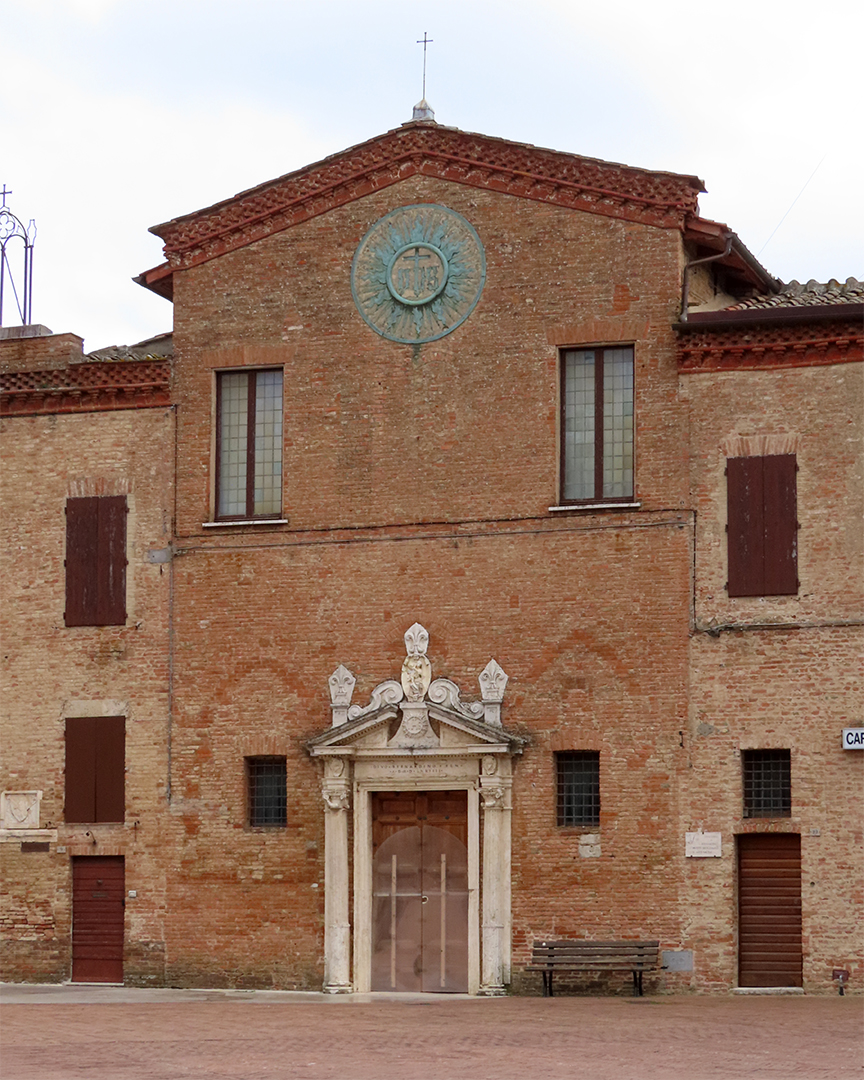
“The Oratory of the Compagnia di San Bernardino is a place of worship in the Piazza San Francesco in Siena. Elevated to minor basilica status in 1925 by Pope Pius XI, it adjoins rooms housing the diocesan museum.[1] It is notable for its frescoes from various 16th- and 17th-century Sienese painters like Sodoma and Domenico Beccafumi. The oratory is almost adjacent to the Basilica of San Francesco, Siena.” (Oratory of the Compagnia di San Bernardino, Wikipedia)
Friday, March 18, 2022
Thursday, March 17, 2022
Wednesday, March 16, 2022
Giraffa
Giraffa (Giraffe) fountain by Pier Luigi Olla, 1970
Piazzetta della Giraffa
Siena, February 2022
“The fountain of Giraffa contrada is a collaboration between architect Salvatore Bocci and sculptor Pier Luigi Olla, and was first used to baptize new contradioli in 1970. The image in brass bas-relief is that of a giraffe wearing a bridle and straining against the reins. The fountain is located in Piazzetta della Giraffa just off of Via del Fosso. The contrada encompasses the Basilica of San Francesco, their contrada church of Santa Maria di Provenzano, and a large green area, on the east side of Siena.” (Siena's Contrada Fountains, La Bella Vita in Italia)
Tuesday, March 15, 2022
Monday, March 14, 2022
Iron ring
Iron ring, Palazzo Piccolomini
Banchi di Sotto
Siena, February 2022
“The Palazzo Piccolomini, also known as the Palazzo Todeschini Piccolomini is a Renaissance-style palace in the city of Siena, region of Tuscany, Italy. It is located on the Banchi di Sotto, at the corner with Via Rinaldini; uphill and west of the church of San Martino, the Loggia del Papa, and the Palazzo delle Papesse, which also built by a Piccolomini family member.” (Palazzo Piccolomini, Wikipedia)
Sunday, March 13, 2022
Piazza del Campo
A view of the square
Piazza del Campo
Siena, February 2022
“Piazza del Campo is the main public space of the historic center of Siena, Tuscany, Italy and is regarded as one of Europe's greatest medieval squares. It is renowned worldwide for its beauty and architectural integrity. The Palazzo Pubblico and its Torre del Mangia, as well as various palazzi signorili surround the shell-shaped piazza. At the northwest edge is the Fonte Gaia. The twice-a-year horse-race, Palio di Siena, is held around the edges of the piazza. The piazza is also the finish of the annual road cycling race Strade Bianche.” (Piazza del Campo, Wikipedia)
Saturday, March 12, 2022
Cappella di Piazza
Cappella di Piazza
Piazza del Campo
Siena, February 2022
“The Chapel of Piazza del Campo, located inside the square of the same name, is a marble construction erected at the base of the Tower of Mangia. The prevailing thesis is that the work was made to thank the gods for the end of the plague that had heavily affected the Tuscan city in the twelfth - thirteenth centuries. The construction works, according to documents of the time, began in 1325 on a project by the architect Domenico D'Agostino and were completed by Giovanni De Cecco around 1376. The Gothic features of the structure are attributable to the latter. The decorations and ornamentation were entrusted first to the sculptor Antonio Federighi and then to Giovanni Antonio Bazzi, known as ‘Sodoma’, who concentrated mainly on the fresco above the altar, unfortunately now almost completely damaged.” (Chapel of Piazza del Campo, Nice Places)
Friday, March 11, 2022
Fonte Gaia
Fonte Gaia (Joyous Fountain)
Piazza del Campo
Siena, February 2022
“The Fonte Gaia (Joyous Fountain) was built in 1419 as an endpoint of the system of conduits bringing water to the city's centre, replacing an earlier fountain completed about 1342 when the water conduits were completed. Under the direction of the Committee of Nine, many miles of tunnels were constructed to bring water in aqueducts to fountains and thence to drain to the surrounding fields. The present fountain, a center of attraction for the many tourists, is in the shape of a rectangular basin that is adorned on three sides with many bas-reliefs with the Madonna surrounded by the Classical and the Christian Virtues, emblematic of Good Government under the patronage of the Madonna. The white marble Fonte Gaia was originally designed and built by Jacopo della Quercia, whose bas-reliefs from the basin's sides are conserved in the Ospedale di St. Maria della Scala in Piazza Duomo. The former sculptures were replaced in 1866 by free copies by Tito Sarrocchi, who omitted Jacopo della Quercia's two nude statues of Rhea Silvia and Acca Larentia, which the nineteenth-century city fathers found too pagan or too nude. When they were set up in 1419, Jacopo della Quercia's nude figures were the first two female nudes, who were neither Eve nor a repentant saint, to stand in a public place since Antiquity.” (Piazza del Campo, Wikipedia)
Thursday, March 10, 2022
Palazzo Pubblico
Palazzo Pubblico (Town Hall)
Piazza del Campo
Siena, February 2022
“The Palazzo Pubblico (town hall) is a palace in Siena, Tuscany, central Italy. Construction began in 1297 to serve as the seat of the Republic of Siena's government, which consisted of the Podestà and Council of Nine, the elected officials who performed executive functions (and judicial ones in secular matters).” (Palazzo Pubblico, Wikipedia)
Wednesday, March 9, 2022
Gavinone
The “gavinone” (the central water drain)
Piazza del Campo
Siena, February 2022
“The open site was a marketplace established before the thirteenth century on a sloping site near the meeting point of the three hillside communities that coalesced to form Siena: the Castellare, the San Martino and the Camollia. Siena may have had earlier Etruscan settlements, but it was not a considerable Roman settlement, and the campo does not lie on the site of a Roman forum, as is sometimes suggested. It was paved in 1349 in fishbone-patterned red brick with 8 lines of travertine, which divide the piazza into 9 sections, radiating from the mouth of the gavinone (the central water drain) in front of the Palazzo Pubblico. The number of divisions is held to be symbolic of the rule of The Nine (Noveschi) who laid out the campo and governed Siena at the height of its mediaeval splendour between 1292-1355. The Campo was and remains the focal point of public life in the City. From the piazza, eleven narrow shaded streets radiate into the city.” (Piazza del Campo, Wikipedia)
Tuesday, March 8, 2022
Monday, March 7, 2022
Sunday, March 6, 2022
Pia de' Tolomei
Plaque remembering Pia de' Tolomei
Palazzo Tolomei
Vicolo della Torre
Siena, February 2022
“Ricorditi di me, che son la Pia;
Siena mi fé, disfecemi Maremma:
salsi colui che 'nnanellata pria
disposando m'avea con la sua gemma.”
(Purgatorio V, 133-136)
(Please remember me, who am La Pia.
Siena made me, in Maremma I was undone.
He knows how, the one who, to marry me,
first gave the ring that held his stone.)
(Purgatory V, 133-136)
“Pia de' Tolomei was an Italian noblewoman from Siena identified as ‘la Pia,’ a minor character in Dante's Divine Comedy who was murdered by her husband. Her brief presence in the poem has inspired many works in art, music, literature, and cinema. Her character in the Divine Comedy is noted for her compassion and serves a greater program among the characters in her canto, as well as the female characters in the entire poem.” (Pia de' Tolomei, Wikipedia)
Saturday, March 5, 2022
Friday, March 4, 2022
Thursday, March 3, 2022
Wednesday, March 2, 2022
L'amore salva il mondo
“L'amore salva il mondo” (Love Saves the World) by Andrea Roggi, 2017
Belvedere di San Prospero
Siena, February 2022
Tuesday, March 1, 2022
Fallen for the Independence
Monument to the Fallen for the Independence by Tito Sarrocchi, 1879
Viale Fruschelli
Siena, February 2022
Subscribe to:
Posts (Atom)