Friday, September 30, 2022
Fuente de las Tres Gracias
Fuente de las Tres Gracias, 1853 (1909)
Plaça de Rodrigo Botet
Valencia, September 2022
“This fountain is a 19th century replica of a famous group by Germain Pilon. The original, kept at the Louvre Museum in Paris, is made of marble and was commissioned by Catherine de Médicis in 1561 to receive the heart of Henri II.”
Thursday, September 29, 2022
Sacristía
Frescos by Luca Giordano
Barrel vault of the sacristy
Catedral de Toledo (Toledo Cathedral)
Calle Cardenal Cisneros
Toledo, September 2022
“The sacristy exhibits treasures from the cathedral's collection, including many major works of art. It is a large space that includes the apartments of the ante-sacristy and the vestuary with its collection of garments. The ante-sacristy is a rectangular room decorated with paintings by the Italian artists Vincenzo Carducci and Eugenio Caxés, as well as Francisco Ricci and the Neapolitan Luca Giordano. The sacristy was designed by Francisco Vergara the Greater and Juan Bautista Monegro, in Herrerian style. The barrel vault, inset with lunettes accommodating the windows, is lavishly decorated with frescos by Luca Giordano. The principal theme is the Clothing of Saint Ildephonsus with the Chasuble, a theme that is repeated throughout the cathedral in paintings and sculpture.” (Toledo Cathedral, Wikipedia)
Wednesday, September 28, 2022
Plaza de Castilla
Puerta de Europa (Gate of Europe) by Philip Johnson & John Burgee, 1996
Caja Madrid Obelisk by Santiago Calatrava, 2009
Plaza de Castilla
Madrid, September 2022
“The Gate of Europe towers (Puerta de Europa), also known as KIO Towers (Torres KIO), are twin office buildings near the Plaza de Castilla in Madrid, Spain. The towers have a height of 114 m (374 ft) and have 26 floors. They were constructed from 1989 to 1996. The Puerta de Europa is the second tallest twin towers in Spain after the Torres de Santa Cruz in Santa Cruz de Tenerife.” (Gate of Europe, Wikipedia)
“The Caja Madrid Obelisk (Spanish: Obelisco de la Caja, Columna de Calatrava or Obelisco de Calatrava) is an obelisk designed by Santiago Calatrava located in the Plaza de Castilla in Madrid, Spain. The monument, intended to commemorate the 300th anniversary of Caja Madrid, was donated by the saving bank to the city of Madrid.” (Caja Madrid Obelisk, Wikipedia)
Tuesday, September 27, 2022
Plaza de la Corredera
Tables and chairs
Plaza de la Corredera
Córdoba, September 2022
“Archaeological excavations have unearthed a series of wonderful mosaics from the Roman period, which are now on show in the Castle of the Christian Monarchs. The present-day square is rectangular with arched porticos running around the ground floor, designed in the style of the old city squares of Castille, of which it is the only one of its kind in Andalusia. It was used in olden days as a bullring, and to this day there is a street named Toril (Bulls’ enclosure). The square has seen everything, from autos de fe and public addresses to public executions during the French Invasion, and now contains a number of cafes and bars, as well as hosting a Medieval Market in the month of January.” (Plaza de la Corredera, Turismo de Córdoba)
Monday, September 26, 2022
Pabellón de Hungría
Pabellón de Hungría (Hungarian pavilion) for Seville Expo '92 by Imre Makovecz
Calle Louis Pasteur
Isla de La Cartuja
Seville, September 2022
“Imre Makovecz's Hungarian pavilion, widely regarded as the most inventive structure at Expo '92 here, soars free from the fair's architectural cacophony like some dizzy fantasy. Built from wood carved in folk styles and bearing a gray slate roof, it seems inspired by village churches but leaps beyond any one model with an exuberance that recalls the Catalan Antonio Gaudi. Inside, the building's conceptual basis becomes clearer, with no loss of wit and style. The interior is divided, one portion symbolizing Hungary facing the West, with a simplified Baroque church front. Pass through that facade and one finds Hungary facing East, the wall exploding with undulating Slavic-style facades (more gray slate) and carved portals. There is also a ‘Tree of Life’ on the Western side, a jumble of roots and branches with a glass floor so that visitors can see the whole thing.” (Makovecz Hungarian Pavilion in Seville, Solaripedia)
Sunday, September 25, 2022
Palau de la Generalitat
Palacio de la Generalidad
Plaza de Manises
Valencia, September 2022
“The design of Palace goes back to 1418. This rectangular building was originally built as a tax office for the Crown. It is flanked by two turrets, while the lower central part set in between gives an impression of unity. Work began in 1421, using a late gothic style. Between 1481 and 1520, the splendid gothic courtyard was enlarged, the Chapel was started and the façade on the Plaza de Manises was built by the architects Pere Compte and Joan Guiverro. The renaissance turret designed by Joan Corbera was finished in 1521. From that period until 1940, when the new turret was built, no other work of importance took place. The new turret was finished in 1952 and the design by architect Luis Albert Ballesteros, was an attempt to copy the original one.” (Palau de la Generalitat, Visit Valencia)
Saturday, September 24, 2022
Gigantes y cabezudos
Gigantes (Processional giants)
Catedral de Toledo (Toledo Cathedral)
Calle Cardenal Cisneros
Toledo, September 2022
“The giants are usually hollow figures several meters tall, with a painted paper maché head and arms, the rest of the body being covered in cloth and other clothing. Their frame is usually made of wood or aluminium, with carton-pierre—a mixture of papier-mâché and plaster of paris—used to make the head and hands. The frame of the body is hidden by cloth, and the arms typically have no structural element to allow them to swing in the air when the giant is turned. Within the frame is an individual controlling the giant. He carries a harness on his shoulder that is linked to the internal structure, and will move and shake the giant in a dance, usually accompanied by a local marching band. Typically, these dances will include at least two giants, the male gigante and the female giantess, called giganta or gigantona, though some towns have multiple couples. The figures usually depict archetypes of the town, such as the bourgeois and the peasant woman, or historical figures of local relevance, such as a founding king and queen, or pairs of Moorish and Christian nobles.” (Processional giant, Wikipedia)
Friday, September 23, 2022
Calle de Alcalá
Street musicians
Calle de Alcalá
Madrid, September 2022
“Calle de Alcalá is among the longest streets in Madrid. It starts at the Puerta del Sol and goes on for 11 kilometres (6.8 mi), to the northeastern outskirts of the city. Henry David Inglis described it in 1837 as ‘long, of superb width, and flanked by a splendid range of unequal buildings’.” (Calle de Alcalá, Wikipedia)
Thursday, September 22, 2022
Fuente del Potro
Fuente del Potro, 1577
Plaza del Potro
Córdoba, September 2022
“The Plaza del Potro is a public square in the Spanish city of Córdoba. Rectangular in shape, one end of the plaza has a fountain topped by the figure of a colt with its front legs raised holding a sign with the coat of arms of the city. This Renaissance-style fountain dates from 1577, and the colt which gives its name to the square was added a century later. Until 1847 was located on the opposite side of the plaza. Since 1924, the other end of the square has a monument dedicated to the Triumph of the archangel Raphael. Among the buildings overlooking the square is the famous Posada del Potro, mentioned by Cervantes in Don Quixote, in addition to the city's Museum of Fine Arts and the Museum Julio Romero de Torres. The reference in "Don Quixote" can be found in the Penguin Classics edition, translated by John D. Rutherford, in Chapter III as ‘... Potro in Cordova ...’, and in the Barnes & Noble edition, translated by Tobias Smollett, in Chapter III as ‘... the spout of Cordoba ...’. The much celebrated reference to the place and neighbourhood is made by an inn keeper making fun of Don Quixote with sarcastic chivalrous references to infamous brothels, disreputable districts and dens of iniquity.” (Plaza del Potro, Wikipedia)
Wednesday, September 21, 2022
Tuesday, September 20, 2022
Palau del Marqués de Dosaigües
Palace of the Marqués de Dos Aguas
(González Martí National Museum
of Ceramics and Decorative Arts)
Raconada de Federico Garcia Sànchiz
Valencia, September 2022
“The Palace of the Marquis of Dos Aguas (Spanish: Palacio del Marqués de Dos Aguas, Valencian: Palau del Marqués de Dosaigües) is a Rococo nobility palace, historically important in the city. It is located in one of the most central locations in the city of Valencia (Spain). It is a stately mansion that was the property of the Marqueses of Dos Aguas and is currently owned by the Spanish State. It houses the González Martí National Museum of Ceramics and Decorative Arts.” (Palace of the Marqués de Dos Aguas, Wikipedia)
Monday, September 19, 2022
Alcázar de Toledo
Alcázar
Calle de la Union
Toledo, September 2022
“The Alcázar of Toledo (Alcázar de Toledo) is a stone fortification located in the highest part of Toledo, Spain. It is a large quadrangular building measuring 60 meters on a side, framed by four large towers 60 meters high, each crowned by the typical Madrid spire. Most of the city was rebuilt between 1939 and 1957 after the siege of the Alcázar during the Spanish Civil War. Once used as a Roman palace in the 3rd century, it was restored under Charles I (Charles V, Holy Roman Emperor) and his son Philip II of Spain in the 1540s. In 1521, Hernán Cortés was received by Charles I at the Alcázar, following Cortes' conquest of the Aztecs. The name is from Arabic al-qaṣr ‘the castle’ (ultimately, from Latin ‘castrum’).” (Alcázar of Toledo, Wikipedia)
Sunday, September 18, 2022
Catedral de la Almudena
Catedral de la Almudena (Almudena Cathedral)
Plaza de la Armería
Madrid, September 2022
“Almudena Cathedral (Santa María la Real de La Almudena) is a Catholic church in Madrid, Spain. It is the seat of the Roman Catholic Archdiocese of Madrid. The cathedral was consecrated by Pope John Paul II in 1993. When the capital of Spain was transferred from Toledo to Madrid in 1561, the seat of the Church in Spain remained in Toledo and the new capital had no cathedral. Plans for a cathedral in Madrid dedicated to the Virgin of Almudena were discussed as early as the 16th century but even though Spain built more than 40 cities overseas during that century, plenty of cathedrals and fortresses, the cost of expanding and keeping the Empire came first and the construction of Madrid's cathedral was postponed. Making the cathedral the largest that the world had ever seen was then a priority. All other main Spanish cities had centuries-old cathedrals, and Madrid had its own old churches, but the construction of Almudena only began in 1879. The cathedral seems to have been built on the site of a medieval mosque that was destroyed in 1083 when Alfonso VI reconquered Madrid. Francisco de Cubas, the Marquis of Cubas, designed and directed the construction in a Gothic revival style. Construction was interrupted by the Spanish Civil War, and the site lay abandoned until 1950, when Fernando Chueca Goitia adapted the plans of de Cubas to a baroque exterior to match the grey and white façade of the Palacio Real that stands directly opposite. The cathedral was completed in 1993, when it was consecrated by Pope John Paul II.” (Almudena Cathedral, Wikipedia)
Saturday, September 17, 2022
Double-tiered arches
Columns and double-tiered arches
Mezquita-Catedral de Córdoba
(Mosque–Cathedral of Córdoba)
Calle Cardenal Herrero
Córdoba, September 2022
“The original mosque had a roughly square floor plan measuring 74 or 79 square meters per side, equally divided between a hypostyle prayer hall to the south and an open courtyard (sahn) to the north. As the mosque was built on a sloping site, a large amount of fill would have been necessary to create a level ground on which to build. The original mosque's most famous architectural innovation, which was preserved and repeated in all subsequent Muslim-era expansions, was its rows of double-tiered arches. Much speculation has been offered on the inspiration for this particular design, including the alleged similarity of the arches to a forest of palm trees from Abd ar-Rahman's youth in Syria; however, a more technical motivation may have been the fact that the available columns being reused from previous buildings were not tall enough on their own to raise the ceiling to the desired height. The precedent of multi-tiered arches was also already present in the Iberian Peninsula thanks to remaining Roman aqueducts (e.g. the Milagros Aqueduct at Mérida).” (Mosque–Cathedral of Córdoba, Wikipedia)
Friday, September 16, 2022
Carmen la Cigarrera
“Carmen la Cigarrera” by Sebastián Santos Rojas, 1973
Paseo de Cristóbal Colón
Seville, September 2022
“Carmen is a story known worldwide about love, passion and jealousy, located in Seville. Written by the French author Prosper Merimé in 1845, it was catapulted to fame thanks to the opera adaptation by Bizet. Its premiere on the 3rd of March 1875 was a failure. Nevertheless, it set the basis for a new type of opera and has become one of the most represented and best known French operas in the world. The story in the novel is set in Seville at the start of the nineteenth century and the lead characters are Carmen, a beautiful gypsy with a temper who works in the Royal Tobacco Factory in Seville and Don José, a former soldier who falls so deeply in love it drives him crazy. Some of the incidents in this renowned opera happen in the most representative locations in Seville, a route which can be explored.” (A walk through Carmen’s Seville, Hotel Ribera de Triana)
Thursday, September 15, 2022
Casa de los Gatos
Casa de los Gatos (House of Cats) by Alfonso Yuste Navarro, 2003
Carrer del Museu
Valencia, September 2022
“Cats are no strangers to urban agglomeration, especially in a warm climate, and the felines of Valencia are no exception. Feral cats roam the streets, looking for a place to rest their bones before being shooed away. The cat house offers them respite. At the foot of a blue wall on Carrer del Museu, the facade of a tiny house attracts the attention of passersby. The house is only a foot or two tall but it is designed in a classically Valencian style. It has a Spanish tiled roof, a little fountain, and a ‘garden’ to the side (actually just one potted plant). The house’s entrance is dark and does not appear to lead to the other side of the wall, but perhaps that’s just a ruse for human intruders. Legend has it that the old woman who previously owned the house behind the gate left it for the feral cats of Valencia to inhabit. Whether or not this is true and whether or not there are any cats behind the wall will have to remain a mystery—to the humans of Valencia at least.” (Cat House, Atlas Obscura)
Wednesday, September 14, 2022
Puerta del Sol
Puerta del Sol
Callejón San José
Toledo, September 2022
“Puerta del Sol is a city gate of Toledo, Spain, built in the late 14th century by the Knights Hospitaller. The medallion above the arch of the gate depicts the ordination of the Visigothic Ildephonsus, Toledo's patron saint. The name of the gate comes from the sun and the moon that were once painted on either side of this medallion. This gate was named because of its orientation to the east, where the sun always rises. The gate is no longer there, but the entrance is.” (Puerta del Sol, Wikipedia)
Tuesday, September 13, 2022
Estación de Madrid Atocha
Estación de Madrid Atocha (Madrid Atocha railway station)
Plaza del Emperador Carlos V
Madrid, September 2022
“Madrid Atocha (Spanish: Estación de Madrid Atocha), also named Madrid Puerta de Atocha, is the first major railway station in Madrid. It is the largest station serving commuter trains (Cercanías), regional trains from the south and southeast, intercity trains from Navarre, Cádiz and Huelva (Andalusia) and La Rioja, and the AVE high speed trains from Girona, Tarragona and Barcelona (Catalonia), Huesca and Zaragoza (Aragon), Sevilla, Córdoba, Málaga and Granada (Andalusia), Valencia, Castellón and Alicante (Levante Region). These train services are run by Spain's national rail company, Renfe. As of 2019, this station has daily services to Marseille, France.” (Madrid Atocha railway station, Wikipedia)
Monday, September 12, 2022
Cristo de los Faroles
Cristo de los Faroles (Christ of the Lanterns) by Juan Navarro León, 1794 Plaza de los Capuchinos
Córdoba, September 2022
“The Christ of Atonement and Mercy, popularly known as the Christ of the Lanterns (Spanish: Cristo de los Faroles), is a large Crucifix located at the Plaza de los Capuchinos in Cordoba, Spain. The sculpture was created in 1794 by the sculptor Juan Navarro León under a commission by the Capuchin friar Diego José de Cádiz. Its popular name comes from the eight lanterns set on iron mounts that illuminate it. The current appearance of the sculpture has developed with the construction of a fence in the 20th century and the replacement of the lanterns with darker ones in 1984.” (Christ of the Lanterns, Wikipedia)
Sunday, September 11, 2022
Capilla del Carmen
Capilla del Carmen by Aníbal González Álvarez-Ossorio, 1928
Puente de Isabel II (Puente de Triana)
Seville, September 2022
“The Capilla de la Virgen del Carmen, better known as ‘La Capillita’ because of its small size, is located next to the Puente de Triana bridge in Seville, and is home to the patron saint of the sea and the Spanish Navy, and the protector of fishermen. The building is a symbol of the Triana neighbourhood. It took from 1924 to 1928 to build and it is the headquarters of the Hermandad de Gloria Nuestra Señora del Carmen brotherhood, although the history of its location begins long before it was built. The building consists of two small elements: a cylindrical chapel adorned by a dome that adjoins a bell tower via a rectangular body through which the building is accessed. There is an abundance of pottery in both the interior and the exterior of the chapel. Its shape resembles a ‘mechero’ (old-fashioned cigarette lighter) the name by which this unique chapel in Triana is popularly known.” (Capilla de la Virgen del Carmen, Andalucia.org)
Saturday, September 10, 2022
Santa Catalina
Santa Catalina
Plaça de Santa Caterina
Valencia, September 2022
“Santa Catalina is a Gothic-style, Roman Catholic church located in the city of Valencia, Spain at the southern end of Plaza de la Reina. The church was built in the early 13th century at the site of a prior mosque. Most of the interior was rebuilt after a fire in 1548 acquiring the baroque style. It has a 16th-century portal of classicist style. The imposing bell tower, with a hexagonal base and five levels, once the site of a minaret, was rebuilt in a Baroque fashion between 1688 and 1705 using the designs of Juan Bautista Viñes. Today still presents the 13th-century gothic exterior. The church was restored in 1785.” (Santa Catalina, Wikipedia)
Friday, September 9, 2022
Retablo
Retablo (Retable)
Catedral de Toledo (Toledo Cathedral)
Calle Cardenal Cisneros
Toledo, September 2022
“The retable of the Cathedral of Toledo is an extremely florid Gothic altarpiece; it is one of the last examples of this artistic style, which was disappearing as the Renaissance began to take hold in Spain. Commissioned by Cardinal Cisneros, the work was begun in 1497 and finished in 1504. Among the architects, painters and sculptors who collaborated in this collective masterwork were: Enrique Egas and Pedro Gumiel (design), Francisco de Amberes and Juan de Borgoña (estofado: the technique of finishing sculpture of wood with gilding and punched patterns, and polychromy), Rodrigo Alemán, Felipe Vigarny, Diego Copín de Holanda y Sebastián de Almonacid (religious images), and Joan Peti (carving and filigree). The retable rises to a great height above the altar; it includes an important statuary and a magnificent, delicate filigree of balusters, spires, small dossals, and chambranles, all done by Joan Peti. It consists of five continuous panels, the center panel being the widest; it is five storeys tall, and the lines of separation are stair-stepped. The themes of the central panel from bottom to top are: the figure of a seated Virgin and Child plated in silver on the predella, above this the tabernacle and a Gothic monstrance carved in wood, then a depiction of the Nativity, and above that, the Ascension. The whole culminates in a monumental scene of Christ's crucifixion at Calvary. Further themes of the life and passion of Jesus are represented on the other panels.” (Toledo Cathedral, Wikipedia)
Thursday, September 8, 2022
Monumento a Miguel de Cervantes
Monument to Miguel de Cervantes, 1929
Plaza de España
Madrid, September 2022
“The Monument to Miguel de Cervantes is an instance of public art located in Madrid, Spain. Erected on the centre of the Plaza de España, it is dedicated to Miguel de Cervantes, widely regarded as the greatest writer in the Spanish language. The monument incorporates a stone monolith with several statues (including Cervantes') and a detached bronze sculptural group representing Don Quixote and Sancho Panza. In 1915, a year before the 300th anniversary of the writer's death, a public contest was announced in order to award the project. The announcement was met with concern among certain reviewers. The winning project was awarded to a dark horse proposal by Rafael Martínez Zapatero and Lorenzo Coullaut Valera that had been derided as overly literary, detail-oriented and anecdotal. The jury's decision was criticised via an open letter signed by at least 109 public figures, including, to name a few, Ramón del Valle Inclán, Alejandro Ferrant, Emilio Carrere, Daniel Zuloaga, Tomás Borrás and Ramón Gómez de la Serna.” (Monument to Miguel de Cervantes, Wikipedia)
Wednesday, September 7, 2022
Torre de la Calahorra
Torre de la Calahorra (Calahorra Tower)
Puente Romano
Córdoba, September 2022
“The Calahorra tower (Spanish: Torre de la Calahorra) is a fortified gate in the historic centre of Córdoba, Spain. The edifice is of Islamic origin. It was first erected by the Almohad Caliphate to protect the nearby Roman Bridge on the Guadalquivir. The tower, standing on the left bank of the river, originally consisted of an arched gate between two. A third tower was added to the existing ones, in the shape of two cylinders connecting them. The tower was declared a national historical monument in 1931. The restoration of the tower, along with the Roman Bridge, Gate of the Bridge and surrounding area, was awarded the European Union Prize for Cultural Heritage / Europa Nostra Award in 2014.” (Calahorra Tower, Wikipedia)
Tuesday, September 6, 2022
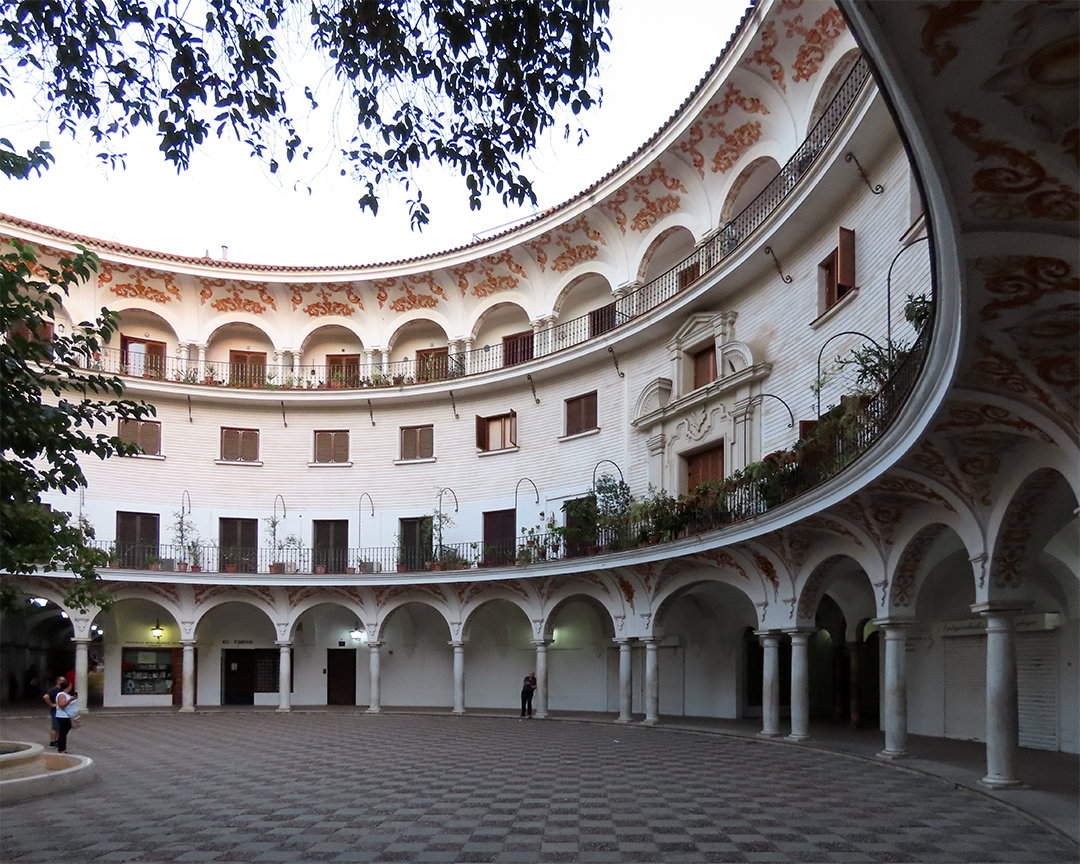
Plaza del Cabildo
Plaza del Cabildo
Calle Almirantazgo, El Arenal
Seville, September 2022
“The Plaza del Cabildo is a small semicircular square in the centre of Seville, located in the Arenal neighbourhood, next to the Cathedral of Seville. The square and the building itself were built on the site of the former college of San Miguel, owned by the Cabildo of the Cathedral, which is where the square got its current name of Plaza del Cabildo. But it was in the middle of the 20th century, around 1950, when the school was demolished. Today, only the façade facing the Avenida de la Constitución and some of the columns that were used in the square remain. The frescoed arcades on the ground floor are the work of the Sevillian painter José Palomar, and are set on marble columns. It is also a building designed by the architect Joaquín Barquín Barrón, in which Seville’s Moorish past is present, as the straight side of the square is occupied by a piece of the Almohad interior wall built in 1184, which came from the Alcazaba.” (Cabildo Square, OWAY Tours)
Monday, September 5, 2022
Assut de l'Or Bridge
Assut de l'Or Bridge (Serreria Bridge) by Santiago Calatrava, 2008
Turìa Gardens
Valencia, September 2022
“The Assut de l'Or Bridge (Valencian: Pont de l'Assut de l'Or, Spanish: Puente de la Presa del Oro) is a white single-pylon cable-stayed bridge in the City of Arts and Sciences in Valencia, Spain, designed by Valencian architect and civil engineer Santiago Calatrava and completed in December 2008. The name l'Assut de l'Or is Valencian for the Dam of the Gold and refers to a dam that was located nearby, although locally it is referred to as El Jamonero (The Ham Holder) or Pont de l'Arpa, Spanish: Puente del Arpa (The Harp Bridge). Calatrava called it the Serreria Bridge. The bridge crosses the Turia Gardens in southeast Valencia, Spain near the east end of the City of Arts and Sciences complex. Its design is a variant of Santiago Calatrava's 1992 design of a cantilever spar cable-stayed bridge in Seville, Spain. In the Serreria bridge, the pylon is curved backward and back-stayed to concrete counterweights in the roadway. The aesthetic effect of the Serreria bridge arises in part from the curved pylon and the 29 parallel cables supporting the bridge deck, accented at night by spot lighting of the cables and the pylon. The bridge deck has two carriageways, three lanes each for cars and one additional lane for a tramway, and a carriageway for only pedestrian and cycle traffic along the middle spine of the deck by the cable stays.” (Assut de l'Or Bridge, Wikipedia)
Sunday, September 4, 2022
Toledo railway station
Railway station
Paseo Rosa
Toledo, September 2022
“The Toledo railway station is a railway station in Toledo, Spain, which was designed by architect Narciso Clavería y de Palacios in the Neo-Mudéjar style. The railway reached Toledo in 1858. The original station was of functional design and was opened on 12 June 1858 by Isabella II of Spain, accompanied by Francisco de Asís, Duke of Cádiz. The present station opened on 24 April 1919. It was designed to echo the historic architecture of the city. The central section is flanked by two side naves, one of which is adjacent to the clock tower, which imitates the style of Toledo church towers. The railway company responsible for the construction of Toledo station, the Compañía de los Ferrocarriles de Madrid a Zaragoza y Alicante, also built other stations in Neo-Mudejar style such as that of Aranjuez. The station has been declared a Property of Cultural Interest and classified as a monument. It was restored in the twenty-first century in connection with the inauguration of the Madrid–Toledo high-speed rail line in 2005.[5] The old line along the Tagus valley in the direction of Aranjuez has been dismantled, and Toledo no longer has a conventional line.” (Toledo railway station, Wikipedia)
Saturday, September 3, 2022
Pasarela de Arganzuela
Pasarela de Arganzuela (Arganzuela Footbridge) by Dominique Perrault, 2011
Madrid Río park
Madrid, September 2022
“The Arganzuela Footbridge is a pedestrian bridge in Madrid, Spain. It partially occupies the land released by the burying of the M-30. Designed by Dominique Perrault, it cost about €13.6M. Building works started in February 2010. The footbridge actually consists of two separate metal cones, one passing over the Madrid Río park while the other crosses over the Manzanares, nearly meeting at an elevated middle point serving as lookout of the Madrid Río park. The combined structure is 278 m long. Perrault employs plate rolling for the curved steel plates along the bridge span. It was opened on 24 March 2011, although initially only for diurnal usage.” (Arganzuela Footbridge, Wikipedia)
Friday, September 2, 2022
Dome of the Mihrab
Dome of the Mihrab
Mezquita-Catedral de Córdoba
(Mosque–Cathedral of Córdoba)
Calle Cardenal Herrero
Córdoba, September 2022
“Above the mihrab, is an equally dazzling dome. The Dome of the Cordova Mosque is built of crisscrossing ribs that create pointed arches all lavishly covered with gold mosaic in a radial pattern. This astonishing building technique anticipates later Gothic rib vaulting, though on a more modest scale. As the mihrab is flanked by two chambers, the dome of the Mosque is also flanked by two other domes.” (Mihrab of Cordoba Mosque, Madain Project)
Thursday, September 1, 2022
Torre Sevilla
Torre Sevilla (Sevilla Tower) by César Pelli, 2015
Calle Gonzalo Jimenez de Quesada
Seville, September 2022
“The tower is located in La Cartuja, the former zone of the Universal Exposition that took place in Seville between April and October 1992. It is located next to the river in an area being redeveloped since the early 2000s. The tower is flanked by two four story podium buildings also designed by César Pelli. The curved edges of the podium buildings define a plaza that opens on the north and south and narrows at the center, creating a pedestrian-scaled commercial street. The tower notably hosts a 5-star hotel, Eurostars Torre Sevilla, along with various offices.” (Sevilla Tower, Wikipedia)
Subscribe to:
Posts (Atom)