Saturday, February 6, 2021
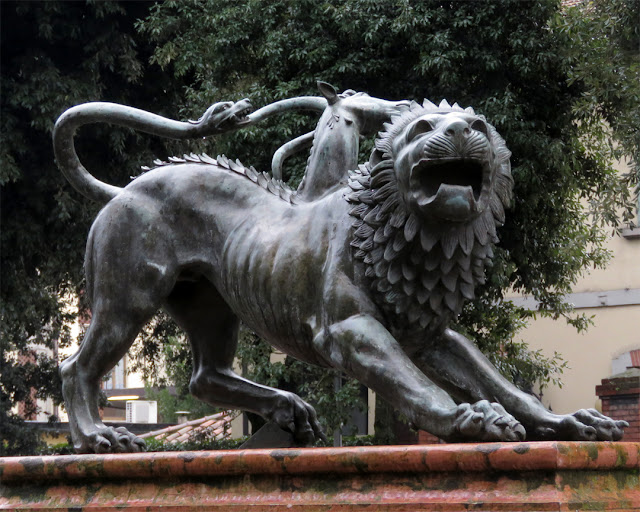
Chimera of Arezzo
Chimera of Arezzo (copy)
Giardini del Porcinai
Viale Michelangelo
Arezzo, February 2021
“The Chimera of Arezzo is regarded as the best example of ancient Etruscan artwork. British art historian, David Ekserdjian, described the sculpture as "one of the most arresting of all animal sculptures and the supreme masterpiece of Etruscan bronze-casting." Made entirely of bronze and measuring 78.5 cm high with a length of 129 cm, it was found alongside a small collection of other bronze statues in Arezzo, an ancient Etruscan and Roman city in Tuscany. The statue was originally part of a larger sculptural group representing a fight between a Chimera and the Greek hero Bellerophon. This sculpture was likely created as a votive offering to the Etruscan god Tinia.” (Chimera of Arezzo, Wikipedia)
Friday, February 5, 2021
Piazza Grande
Apse of Santa Maria della Pieve, the old Tribunal Palace, and the Lay Fraternity
Piazza Grande
Arezzo, February 2021
“The Piazza Grande is the most noteworthy medieval square in the city, opening behind the 13th century Romanesque apse of Santa Maria della Pieve. Once the main marketplace of the city, it is currently the site of the Giostra del Saracino (Joust of the Saracen). It has a sloping pavement in red brick with limestone geometrical lines. Aside from the apse of the church, other landmarks of the square include the Palace of the Lay Fraternity, a 14th–15th century palazzo, with a Gothic ground floor and a quattrocento second floor by Bernardo Rossellino.” (Arezzo, Wikipedia)
Thursday, February 4, 2021
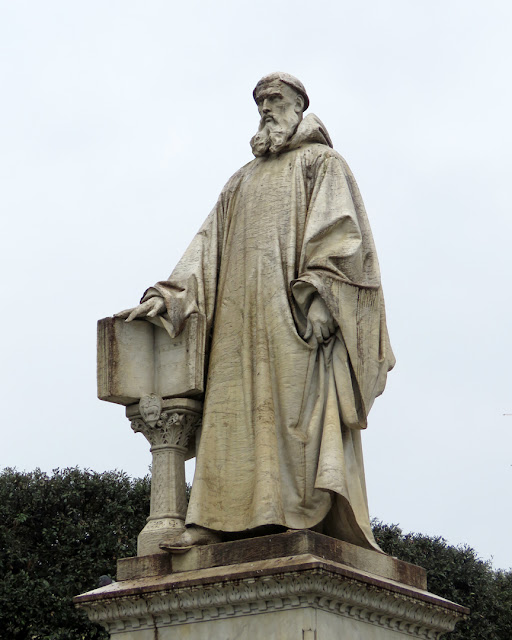
Guido of Arezzo
Guido of Arezzo (Guido Monaco) by Salvino Salvini, 1882
Piazza Guido Monaco
Arezzo, February 2021
“Guido of Arezzo (c. 991 – after 1033) was an Italian music theorist and pedagogue of the medieval era. He is regarded as the inventor of modern staff notation that replaced neumatic notation. His text, the Micrologus, was the second most widely distributed treatise on music in the Middle Ages (after the writings of Boethius). Guido was a Benedictine monk from the Italian city-state of Arezzo. Recent research has dated his Micrologus to 1025 or 1026; since Guido stated in a letter that he was thirty-four when he wrote it, his birthdate is presumed to be around 991 or 992. His early career was spent at the monastery of Pomposa, on the Adriatic coast near Ferrara. While there, he noted the difficulty that singers had in remembering Gregorian chants. He came up with a method for teaching the singers to learn chants in a short time, and quickly became famous throughout north Italy. However, around 1025 he attracted the hostility of the other monks at the abbey who resisted his musical innovations, prompting him to move to Arezzo, a town which had no abbey, but which did have a large group of cathedral singers, whose training Bishop Tedald invited him to conduct.” (Guido of Arezzo, Wikipedia)
Wednesday, February 3, 2021
Duomo di Arezzo
Duomo di Arezzo (Arezzo Cathedral)
Piazza del Duomo
Arezzo, February 2021
“Arezzo Cathedral (Duomo di Arezzo, Cattedrale di Ss. Donato e Pietro) is a Roman Catholic cathedral in the city of Arezzo in Tuscany, Italy. It is located on the site of a pre-existing Palaeo-Christian church and, perhaps, of the ancient city's acropolis. The first cathedral of Arezzo was built on the nearby Pionta Hill, over the burial place of Donatus of Arezzo, martyred in 363. In 1203 Pope Innocent III had the cathedral moved within the city's walls, to the current site. The cathedral however lost the relics of Donatus, which were transferred to the church of San Donato in Castiglione Messer Raimondo (in what is now the province of Teramo). In spite of this, the cathedral is still dedicated to Saint Donatus and at the high altar houses a 14th-century arch named after him.” (Arezzo Cathedral, Wikipedia)
Tuesday, February 2, 2021
Francesco Petrarca
Monument to Francesco Petrarca by Alessandro Lazzerini, 1928
Passeggio del Prato
Arezzo, February 2021
“Four metre tall, marble statue of Francesco Petrarca high atop a massive sculptural group, including a busy and eclectic collection of elements drawn from Petrarch's life and poetry. The group right on the front of the base portrays the sentiment of Peace: a mother pulls away her son from fraticidal warfare (on the shield is the text ‘agitans discordia fratres’), clinging to herself. The muscular male youth with arms outstretched, is meant to be crying out for peace, ‘pace, pace, pace’ (the closing of Petrarch's poem ‘Italia mia’). As an allusion to the Triumph of Fame, the main group on the back of the monument shows the poet's coronation with a laurel wreath by Senator Orso dell'Anguillara in 1341. The figures present at the ceremony show the various social classes. Among these are a warrior with the appearance of the Duke of the Abruzzi, a poet with that of Gabriele d'Annunzio and a female figure, where Lazzerini's wife was the model.” (Petrarch, Statues - Hither & Thither)
Monday, February 1, 2021
Giorgio Vasari
Giorgio Vasari by Giuseppe Castellucci & Alessandro Lazzerini, 1911
Palazzo delle Logge
Piazza Grande
Arezzo, February 2021
“Marble relief of Vasari, as if he is looking out of a window. It is placed on the first pillar of the loggia designed by him. The relief is designed by Giuseppe Castellucci and executed by Alessandro Lazzerini.” (Giorgio Vasari, Statues - Hither & Thither)
Subscribe to:
Posts (Atom)