Showing posts with label Toledo. Show all posts
Sunday, November 13, 2022
Sagrado Corazón de Jesús
Monumento al Sagrado Corazón de Jesús (Monument to the Sacred Heart of Jesus) by Juan García Ramírez, 1931
Plaza del Sagrado Corazón
Avenida de Carlos III
Toledo, September 2022
Tuesday, November 8, 2022
Puente de San Martín
Puente de San Martín (San Martin's Bridge)
Bajada San Martín
Toledo, September 2022
“The Puente de San Martín (English: St Martin's Bridge) is a medieval bridge across the river Tagus in Toledo, Spain. The Puente de San Martín features five arches, with the largest in the middle having a span of 40 meters. Only very few bridges in the world were that long at the time of its construction. The bridge was constructed in the late 14th century by archbishop Pedro Tenorio to provide access to the old town from the west, complementing the older Puente de Alcántara linking to the east. Both sides of the bridge were heavily fortified with towers, the more recent dating from the 16th century.” (Puente de San Martín, Wikipedia)
Thursday, November 3, 2022
Bancos
Bancos (Benches)
Plaza de Zocodover
Toledo, September 2022
“The second expansion was done and dates from the beginning of the 17th century. This consisted in the demolition of a series of houses of little value that seems to be difficult the total vision of Zocodover from its top to the bottom and vice versa. Never more arches were realized and probably this fact is due to that it was not wanted to remove meters to the square. Nowadays Zocodover is one of the places of the city where many events and celebrations are held, as well as serving as a popular meeting point and enjoyment of the Toledo and above all a must for the thousands of tourists who mark the streets of the historical quarter throughout the year.” (Plaza de Zocodover, Wikipedia)
Saturday, October 29, 2022
Victoria
“Victoria” (Victory) by Juan de Ávalos, 1961
Monumento a la gesta del Alcázar
Calle de la Union
Toledo, September 2022
“The origin of the name Zocodover comes from the Arabic language sūq ad-dawābb, which means ‘market of burden beasts’. This place was also the place where bullfighting and the cucañas were organized in the celebrations of the locality. It has been, therefore, the nerve center of the social life of the city since medieval times. But Zocodover was also a center for more mournful acts like the autos-da-fé of the Inquisition or the public execution of the prisoners. It is when the old square was destroyed by a fire on October 29, 1589 that the decision was taken to build a new one. In 1854 an ambitious project is drawn up, by the hand of the technician Santiago Martín Ruiz, to reorganize the plaza de Zocodover, transforming it into a rectangular portico square.” (Plaza de Zocodover, Wikipedia)
Monday, October 24, 2022
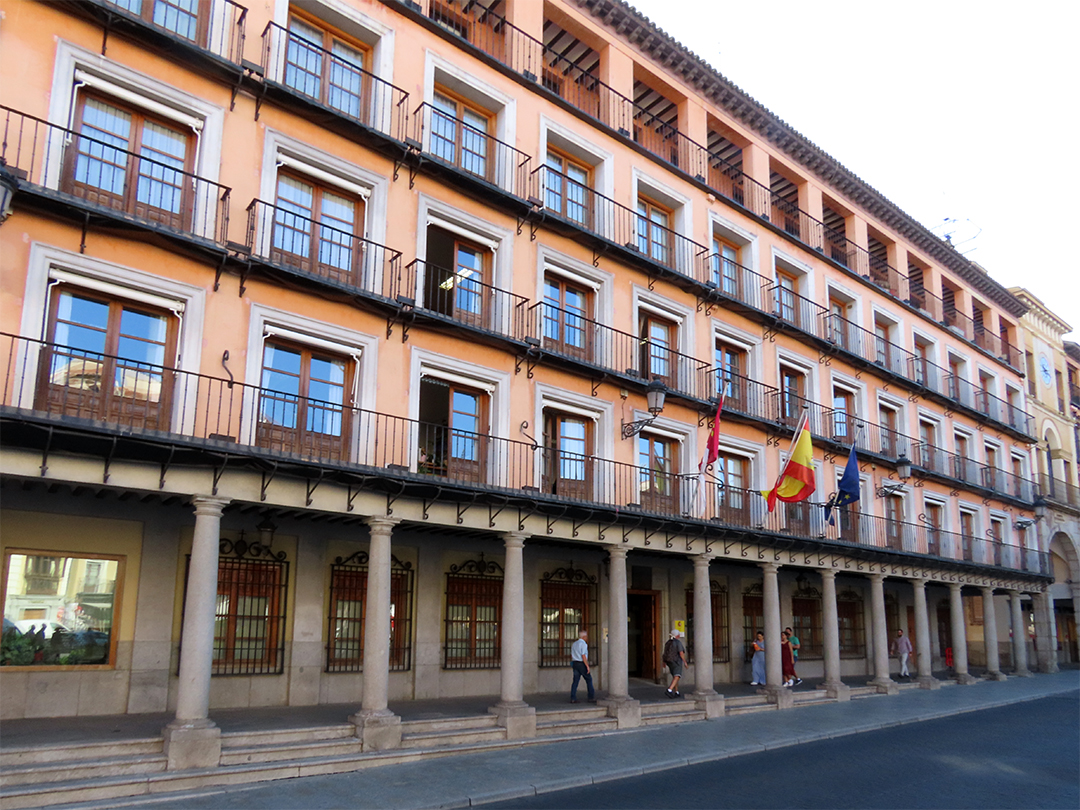
Delegación del Gobierno
Plaza de Zocodover
Toledo, September 2022
“The origin of the name Zocodover comes from the Arabic language sūq ad-dawābb, which means ‘market of burden beasts’. This place was also the place where bullfighting and the cucañas were organized in the celebrations of the locality. It has been, therefore, the nerve center of the social life of the city since medieval times. But Zocodover was also a center for more mournful acts like the autos-da-fé of the Inquisition or the public execution of the prisoners. It is when the old square was destroyed by a fire on October 29, 1589 that the decision was taken to build a new one. In 1854 an ambitious project is drawn up, by the hand of the technician Santiago Martín Ruiz, to reorganize the plaza de Zocodover, transforming it into a rectangular portico square.” (Plaza de Zocodover, Wikipedia)
Wednesday, October 19, 2022
Torreón occidental
Torreón occidental (Western tower) Puente de Alcántara
Toledo, September 2022
“During the reign of Alfonso X of Castile it suffered serious damage and was rebuilt. The western tower belongs to this period, later decorated under the reign of the Catholic Monarchs, whose arms decorate its walls. The fruit of the pomegranate (the emblem of Granada) is missing from them, because the Reconquista had not finished at that time.” (Puente de Alcántara, Wikipedia)
Friday, October 14, 2022
Puerta de Bisagra
Puerta de Bisagra
Calle Real del Arrabal
Toledo, September 2022
“The Puerta de Bisagra (originally Bab al-Saqra, also called Puerta de Alfonso VI) is a city gate of Toledo, Spain. The structure was constructed in the 10th century, in the time of the Moorish Taifa of Toledo in Islamic Al-Andalus. It is also called 'Bisagra Antigua' to distinguish it from the Puerta de Bisagra Nueva which was built in 1559. The gate was the main entrance to the city and dates from the Moorish period.” (Puerta de Bisagra, Wikipedia)
Sunday, October 9, 2022
Cristo de la Luz
Ermita del Cristo de la Luz
Calle Cristo de la Luz
Toledo, September 2022
“The Mosque of Cristo de la Luz is a Catholic chapel and former mosque in Toledo, Spain. It is the one of the ten that existed in the city during the Moorish period. The edifice was then known as Mezquita Bab-al-Mardum, deriving its name from the city gate Bab al-Mardum. It is located near the Puerta del Sol, in an area of the city once called Medina where wealthy Muslims used to live.” (Cristo de la Luz, Wikipedia)
Tuesday, October 4, 2022
El Transparente
“El Transparente” by Narciso Tomé and his four sons, 1732
Catedral de Toledo (Toledo Cathedral)
Calle Cardenal Cisneros
Toledo, September 2022
“El Transparente is a Baroque altarpiece in the ambulatory of the Cathedral of Toledo. Its name refers to the unique illumination provided by a large skylight cut very high up into the thick wall across the ambulatory, and another hole cut into the back of the altarpiece itself to allow shafts of sunlight to strike the tabernacle. This lower hole also allows persons in the ambulatory to see through the altarpiece to the tabernacle, as if were transparent, so to speak. It was created in 1729-1732 by Narciso Tomé and his four sons (two architects, one painter and one sculptor). The use of light and of mixed materials (marble, bronze, paint, stucco) may reflect the influence of Bernini's Cathedra Petri in St Peter's Basilica, Rome. Its execution was ordered by Diego de Astorga y Céspedes, Archbishop of Toledo. The Bishop wished to mark the presence of the Holy Sacrament with a glorious monument. The monument cost 200,000 ducats and aroused great enthusiasm, even a celebratory poem wherein the monument was acclaimed 'the Eighth Wonder of the World'. Cardinal Astorga y Céspedes is buried at the feet of El Transparente.” (El Transparente, Wikipedia)
Thursday, September 29, 2022
Sacristía
Frescos by Luca Giordano
Barrel vault of the sacristy
Catedral de Toledo (Toledo Cathedral)
Calle Cardenal Cisneros
Toledo, September 2022
“The sacristy exhibits treasures from the cathedral's collection, including many major works of art. It is a large space that includes the apartments of the ante-sacristy and the vestuary with its collection of garments. The ante-sacristy is a rectangular room decorated with paintings by the Italian artists Vincenzo Carducci and Eugenio Caxés, as well as Francisco Ricci and the Neapolitan Luca Giordano. The sacristy was designed by Francisco Vergara the Greater and Juan Bautista Monegro, in Herrerian style. The barrel vault, inset with lunettes accommodating the windows, is lavishly decorated with frescos by Luca Giordano. The principal theme is the Clothing of Saint Ildephonsus with the Chasuble, a theme that is repeated throughout the cathedral in paintings and sculpture.” (Toledo Cathedral, Wikipedia)
Saturday, September 24, 2022
Gigantes y cabezudos
Gigantes (Processional giants)
Catedral de Toledo (Toledo Cathedral)
Calle Cardenal Cisneros
Toledo, September 2022
“The giants are usually hollow figures several meters tall, with a painted paper maché head and arms, the rest of the body being covered in cloth and other clothing. Their frame is usually made of wood or aluminium, with carton-pierre—a mixture of papier-mâché and plaster of paris—used to make the head and hands. The frame of the body is hidden by cloth, and the arms typically have no structural element to allow them to swing in the air when the giant is turned. Within the frame is an individual controlling the giant. He carries a harness on his shoulder that is linked to the internal structure, and will move and shake the giant in a dance, usually accompanied by a local marching band. Typically, these dances will include at least two giants, the male gigante and the female giantess, called giganta or gigantona, though some towns have multiple couples. The figures usually depict archetypes of the town, such as the bourgeois and the peasant woman, or historical figures of local relevance, such as a founding king and queen, or pairs of Moorish and Christian nobles.” (Processional giant, Wikipedia)
Monday, September 19, 2022
Alcázar de Toledo
Alcázar
Calle de la Union
Toledo, September 2022
“The Alcázar of Toledo (Alcázar de Toledo) is a stone fortification located in the highest part of Toledo, Spain. It is a large quadrangular building measuring 60 meters on a side, framed by four large towers 60 meters high, each crowned by the typical Madrid spire. Most of the city was rebuilt between 1939 and 1957 after the siege of the Alcázar during the Spanish Civil War. Once used as a Roman palace in the 3rd century, it was restored under Charles I (Charles V, Holy Roman Emperor) and his son Philip II of Spain in the 1540s. In 1521, Hernán Cortés was received by Charles I at the Alcázar, following Cortes' conquest of the Aztecs. The name is from Arabic al-qaṣr ‘the castle’ (ultimately, from Latin ‘castrum’).” (Alcázar of Toledo, Wikipedia)
Wednesday, September 14, 2022
Puerta del Sol
Puerta del Sol
Callejón San José
Toledo, September 2022
“Puerta del Sol is a city gate of Toledo, Spain, built in the late 14th century by the Knights Hospitaller. The medallion above the arch of the gate depicts the ordination of the Visigothic Ildephonsus, Toledo's patron saint. The name of the gate comes from the sun and the moon that were once painted on either side of this medallion. This gate was named because of its orientation to the east, where the sun always rises. The gate is no longer there, but the entrance is.” (Puerta del Sol, Wikipedia)
Friday, September 9, 2022
Retablo
Retablo (Retable)
Catedral de Toledo (Toledo Cathedral)
Calle Cardenal Cisneros
Toledo, September 2022
“The retable of the Cathedral of Toledo is an extremely florid Gothic altarpiece; it is one of the last examples of this artistic style, which was disappearing as the Renaissance began to take hold in Spain. Commissioned by Cardinal Cisneros, the work was begun in 1497 and finished in 1504. Among the architects, painters and sculptors who collaborated in this collective masterwork were: Enrique Egas and Pedro Gumiel (design), Francisco de Amberes and Juan de Borgoña (estofado: the technique of finishing sculpture of wood with gilding and punched patterns, and polychromy), Rodrigo Alemán, Felipe Vigarny, Diego Copín de Holanda y Sebastián de Almonacid (religious images), and Joan Peti (carving and filigree). The retable rises to a great height above the altar; it includes an important statuary and a magnificent, delicate filigree of balusters, spires, small dossals, and chambranles, all done by Joan Peti. It consists of five continuous panels, the center panel being the widest; it is five storeys tall, and the lines of separation are stair-stepped. The themes of the central panel from bottom to top are: the figure of a seated Virgin and Child plated in silver on the predella, above this the tabernacle and a Gothic monstrance carved in wood, then a depiction of the Nativity, and above that, the Ascension. The whole culminates in a monumental scene of Christ's crucifixion at Calvary. Further themes of the life and passion of Jesus are represented on the other panels.” (Toledo Cathedral, Wikipedia)
Sunday, September 4, 2022
Toledo railway station
Railway station
Paseo Rosa
Toledo, September 2022
“The Toledo railway station is a railway station in Toledo, Spain, which was designed by architect Narciso Clavería y de Palacios in the Neo-Mudéjar style. The railway reached Toledo in 1858. The original station was of functional design and was opened on 12 June 1858 by Isabella II of Spain, accompanied by Francisco de Asís, Duke of Cádiz. The present station opened on 24 April 1919. It was designed to echo the historic architecture of the city. The central section is flanked by two side naves, one of which is adjacent to the clock tower, which imitates the style of Toledo church towers. The railway company responsible for the construction of Toledo station, the Compañía de los Ferrocarriles de Madrid a Zaragoza y Alicante, also built other stations in Neo-Mudejar style such as that of Aranjuez. The station has been declared a Property of Cultural Interest and classified as a monument. It was restored in the twenty-first century in connection with the inauguration of the Madrid–Toledo high-speed rail line in 2005.[5] The old line along the Tagus valley in the direction of Aranjuez has been dismantled, and Toledo no longer has a conventional line.” (Toledo railway station, Wikipedia)
Subscribe to:
Posts (Atom)