Showing posts with label Seville. Show all posts

Thursday, November 10, 2022

Alameda de Hércules

Roman columns with statues of Hercules and Julius Caesar, Alameda de Hércules, Seville

Roman columns with statues of Hercules and Julius Caesar
Alameda de Hércules
Seville, September 2022

“The Alameda de Hércules (Hercules mall), or simply La Alameda, is a garden square or mall in Seville, southern Spain. Built in 1574, it was originally a promenaded public garden, named after the eight rows of white poplar trees (álamos in Spanish) that fill its central part. Located in the northern half of the city's casco antiguo (historic center), between the Guadalquivir River and the Macarena neighbourhood, it was the oldest public garden in Spain and Europe.” (Alameda de Hércules, Wikipedia)

Saturday, November 5, 2022

Torre Schindler

Torre Schindler by Guillermo Vázquez Consuegra, Pabellón de la Navegación, Camino de los Descubrimientos, Isla de la Cartuja, Seville

Torre Schindler by Guillermo Vázquez Consuegra, 1992
Pabellón de la Navegación
Camino de los Descubrimientos
Isla de la Cartuja
Seville, September 2022

“Originally built as an observation tower for the 1992 Expo, the 50m-high Torre Schindler is now part of the Pabellón de la Navegación museum. Elevators take you to the top, from where you can admire sweeping views of the city.” (Torre Mirador, Lonely Planet)

Monday, October 31, 2022

La Giralda

La Giralda, Avenida de la Constitución, Seville

La Giralda
Avenida de la Constitución
Seville, September 2022

“The Giralda (Spanish: La Giralda) is the bell tower of Seville Cathedral in Seville, Spain.[1] It was built as the minaret for the Great Mosque of Seville in al-Andalus, Moorish Spain, during the reign of the Almohad dynasty, with a Renaissance-style belfry added by the Catholics after the expulsion of the Muslims from the area. The Giralda was registered in 1987 as a World Heritage Site by UNESCO, along with the Alcázar and the General Archive of the Indies. The tower is 104.1 m (342 ft) in height and remains one of the most important symbols of the city, as it has been since the Middle Ages.” (Giralda, Wikipedia)

Wednesday, October 26, 2022

Templete del Triunfo

Templete del Triunfo de Nuestra Señora del Patrocinio by José Tomás Zambrano, Calle Santo Tomás, Seville

Templete del Triunfo de Nuestra Señora del Patrocinio by José Tomás Zambrano, 1756
Calle Santo Tomás, Plaza del Triunfo
Seville, September 2022

Friday, October 21, 2022

Torre Triana

Torre Triana by Francisco Javier Sáenz de Oiza, Calle Juan Antonio de Vizarrón, Seville

Torre Triana by Francisco Javier Sáenz de Oiza, 1993
Calle Juan Antonio de Vizarrón
Seville, September 2022

“Torre Triana, an administrative building of the Government of Andalusia in Seville, was built in 1993. It was designed by the Navarran architect Francisco Javier Saenz de Oiza, inspired from the Sant'Angelo castle of the city of Rome. It is the largest administrative building of the Government of Andalusia. Postmodern style with the yellow color and circular shape makes the building very particular.” (Torre Triana, Architectuul)

Sunday, October 16, 2022

Torre del Oro

Torre del Oro, Paseo de Cristóbal Colón, Seville

Torre del Oro
Paseo de Cristóbal Colón
Seville, September 2022

“The Torre del Oro (Arabic romanized: burj aḏẖ-ḏẖahab, lit. Tower of Gold) is a dodecagonal military watchtower in Seville, southern Spain. It was erected by the Almohad Caliphate in order to control access to Seville via the Guadalquivir river. Constructed in the first third of the 13th century, the tower served as a prison during the Middle Ages. Its name comes from the golden shine it projected on the river, due to its building materials (a mixture of mortar, lime and pressed hay). The tower is divided into three levels, the first level, dodecagonal, was built in 1220 by order of the Almohad governor of Seville, Abù l-Ulà; As for the second level, of only 8 meters, also dodecagonal, was built by Peter of Castile in the fourteenth century, a hypothesis that has been confirmed by archaeological studies; The third and uppermost being circular in shape was added after the previous third level, Almohad, was damaged by the 1755 Lisbon earthquake. Rebuilding of the third level was made by Brusselian military engineer Sebastian Van der Borcht in 1760.” (Torre del Oro, Wikipedia)

Tuesday, October 11, 2022

Las Setas

Las Setas (The Mushrooms), Metropol Parasol, Plaza de la Encarnación, Seville

“Las Setas” (The Mushrooms), Metropol Parasol
Plaza de la Encarnación
Seville, September 2022

“Setas de Sevilla (Mushrooms of Seville) or Las Setas (The Mushrooms), initially titled Metropol Parasol, is a wooden structure located at La Encarnación square in the old quarter of Seville, Spain. It was designed by the German architect Jürgen Mayer and completed in April 2011. It has dimensions of 150 by 70 metres (490 by 230 ft) and an approximate height of 26 metres (85 ft) and claims to be the largest wooden structure in the world. Its appearance, location, delays and cost overruns in construction resulted in much public controversy.” (Metropol Parasol, Wikipedia)

Thursday, October 6, 2022

Plaza de España

Plaza de España, Parque de María Luisa, Seville

Plaza de España
Parque de María Luisa
Seville, September 2022

“The Plaza de España (Spain Square, in English) is a plaza in the Parque de María Luisa (Maria Luisa Park), in Seville, Spain. It was built in 1928 for the Ibero-American Exposition of 1929. It is a landmark example of Regionalism Architecture, mixing elements of the Baroque Revival, Renaissance Revival and Moorish Revival (Neo-Mudéjar) styles of Spanish architecture.” (Plaza de España, Wikipedia)

Saturday, October 1, 2022

Maestranza

Plaza de toros de la Real Maestranza de Caballería de Sevilla, Paseo de Cristóbal Colón, Seville

Plaza de toros de la Real Maestranza de Caballería de Sevilla
Paseo de Cristóbal Colón
Seville, September 2022

“The Plaza de toros de la Real Maestranza de Caballería de Sevilla is a 12,000-capacity bullring in Seville, Spain. During the annual Seville Fair in Seville, it is the site of one of the most well-known bullfighting festivals in the world. It is a part of the Real Maestranza de Caballería de Sevilla, a noble guild established for traditional cavalry training. The ring itself is considered one of the city's most enjoyable tourist attractions and is certainly one of the most visited. As a stage for bullfighting, it is considered one of the world's most challenging environments because of its history, characteristics, and viewing public, which is considered one of the most unforgiving in all of bullfighting fandom.” (Maestranza, Wikipedia)

Monday, September 26, 2022

Pabellón de Hungría

Pabellón de Hungría, Hungarian pavilion for Seville Expo '92 by Imre Makovecz, Calle Louis Pasteur, Isla de La Cartuja, Seville

Pabellón de Hungría (Hungarian pavilion) for Seville Expo '92 by Imre Makovecz
Calle Louis Pasteur
Isla de La Cartuja
Seville, September 2022

“Imre Makovecz's Hungarian pavilion, widely regarded as the most inventive structure at Expo '92 here, soars free from the fair's architectural cacophony like some dizzy fantasy. Built from wood carved in folk styles and bearing a gray slate roof, it seems inspired by village churches but leaps beyond any one model with an exuberance that recalls the Catalan Antonio Gaudi. Inside, the building's conceptual basis becomes clearer, with no loss of wit and style. The interior is divided, one portion symbolizing Hungary facing the West, with a simplified Baroque church front. Pass through that facade and one finds Hungary facing East, the wall exploding with undulating Slavic-style facades (more gray slate) and carved portals. There is also a ‘Tree of Life’ on the Western side, a jumble of roots and branches with a glass floor so that visitors can see the whole thing.” (Makovecz Hungarian Pavilion in Seville, Solaripedia)

Wednesday, September 21, 2022

El Caracol

El Caracol (The Snail) by Chiqui Díaz, Calle Puente y Pellón, Seville

“El Caracol” (The Snail) by Chiqui Díaz
Calle Puente y Pellón
Seville, September 2022

Friday, September 16, 2022

Carmen la Cigarrera

Carmen la Cigarrera by Sebastián Santos Rojas, Paseo de Cristóbal Colón, Seville

“Carmen la Cigarrera” by Sebastián Santos Rojas, 1973
Paseo de Cristóbal Colón
Seville, September 2022

“Carmen is a story known worldwide about love, passion and jealousy, located in Seville. Written by the French author Prosper Merimé in 1845, it was catapulted to fame thanks to the opera adaptation by Bizet. Its premiere on the 3rd of March 1875 was a failure. Nevertheless, it set the basis for a new type of opera and has become one of the most represented and best known French operas in the world. The story in the novel is set in Seville at the start of the nineteenth century and the lead characters are Carmen, a beautiful gypsy with a temper who works in the Royal Tobacco Factory in Seville and Don José, a former soldier who falls so deeply in love it drives him crazy. Some of the incidents in this renowned opera happen in the most representative locations in Seville, a route which can be explored.” (A walk through Carmen’s Seville, Hotel Ribera de Triana)

Sunday, September 11, 2022

Capilla del Carmen

Capilla del Carmen by Aníbal González Álvarez-Ossorio, Puente de Isabel II (Puente de Triana), Seville

Capilla del Carmen by Aníbal González Álvarez-Ossorio, 1928
Puente de Isabel II (Puente de Triana)
Seville, September 2022

“The Capilla de la Virgen del Carmen, better known as ‘La Capillita’ because of its small size, is located next to the Puente de Triana bridge in Seville, and is home to the patron saint of the sea and the Spanish Navy, and the protector of fishermen. The building is a symbol of the Triana neighbourhood. It took from 1924 to 1928 to build and it is the headquarters of the Hermandad de Gloria Nuestra Señora del Carmen brotherhood, although the history of its location begins long before it was built. The building consists of two small elements: a cylindrical chapel adorned by a dome that adjoins a bell tower via a rectangular body through which the building is accessed. There is an abundance of pottery in both the interior and the exterior of the chapel. Its shape resembles a ‘mechero’ (old-fashioned cigarette lighter) the name by which this unique chapel in Triana is popularly known.” (Capilla de la Virgen del Carmen, Andalucia.org)

Tuesday, September 6, 2022

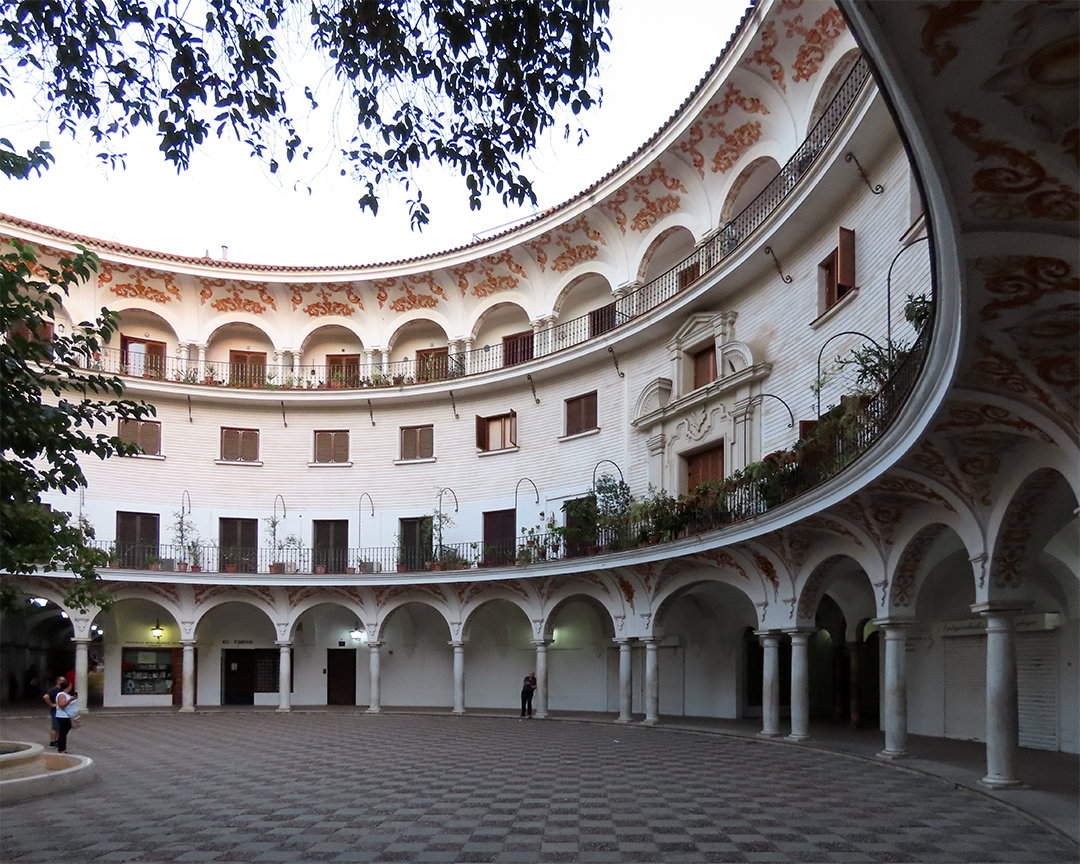
Plaza del Cabildo

Plaza del Cabildo, Calle Almirantazgo, El Arenal, Seville

Plaza del Cabildo
Calle Almirantazgo, El Arenal
Seville, September 2022

“The Plaza del Cabildo is a small semicircular square in the centre of Seville, located in the Arenal neighbourhood, next to the Cathedral of Seville. The square and the building itself were built on the site of the former college of San Miguel, owned by the Cabildo of the Cathedral, which is where the square got its current name of Plaza del Cabildo. But it was in the middle of the 20th century, around 1950, when the school was demolished. Today, only the façade facing the Avenida de la Constitución and some of the columns that were used in the square remain. The frescoed arcades on the ground floor are the work of the Sevillian painter José Palomar, and are set on marble columns. It is also a building designed by the architect Joaquín Barquín Barrón, in which Seville’s Moorish past is present, as the straight side of the square is occupied by a piece of the Almohad interior wall built in 1184, which came from the Alcazaba.” (Cabildo Square, OWAY Tours)

Thursday, September 1, 2022

Torre Sevilla

Torre Sevilla, Sevilla Tower by César Pelli, Calle Gonzalo Jimenez de Quesada, Seville

Torre Sevilla (Sevilla Tower) by César Pelli, 2015
Calle Gonzalo Jimenez de Quesada
Seville, September 2022

“The tower is located in La Cartuja, the former zone of the Universal Exposition that took place in Seville between April and October 1992. It is located next to the river in an area being redeveloped since the early 2000s. The tower is flanked by two four story podium buildings also designed by César Pelli. The curved edges of the podium buildings define a plaza that opens on the north and south and narrows at the center, creating a pedestrian-scaled commercial street. The tower notably hosts a 5-star hotel, Eurostars Torre Sevilla, along with various offices.” (Sevilla Tower, Wikipedia)